How to Do a Bass Swap: The DJ Technique Step by Step
The bass swap is the move that turns two tracks into one. Get it right and the crowd barely notices the change. Get it wrong and the floor turns to mud. Here's what it is, how to do it, where to put it and how to practise it on your own music.
What a bass swap is, and why you need one
Every track in a house or techno set has a kick and a bassline sitting in the low end. Play two of them at full weight and they fight. The kicks flam, the basslines clash, and the whole mix gets loud and muddy.
A bass swap fixes that. You start the incoming track with its bass cut, let the two tracks run together, then hand the low end over at one moment. Before the swap the old track carries the bass. After it, the new one does. There is only ever one bassline at a time.
It's the heart of a clean blend. If you're just starting out, our guide to learning to DJ with your own music puts it in context with everything else.
How to do a bass swap, step by step
- Kill the incoming LOW before you start. Turn the new track's LOW knob fully down while it's still cued. Keep its fader down and sync the tempo.
- Start the blend. Press play on a downbeat and bring the fader up. You'll hear the new track's hats, chords and percussion over the old track's groove, but no second bassline.
- Count to the swap. Pick the bar line you're swapping on before you start, and count the bars down to it. The last bar, count the beats.
- Swap on the first beat of the bar. Turn the outgoing LOW out and the incoming LOW in, together. One quick move, or a fast cross over a beat. Either way both knobs move at once.
- Fade the old track out. With its bass gone, the outgoing track is just texture now. Bring its fader down over the next few bars.
The bass swap is one of three EQ jobs in a blend. Our guide to EQing a DJ transition covers the highs and mids too.
When to swap the bass
The swap should land somewhere the music already changes, so it sounds like part of the track. That means a phrase line: the start of an 8, 16 or 32-bar section. If phrasing is new to you, read how to mix on the phrase first.
- Where the outgoing track winds down. Most dance tracks strip back in the outro. Swapping as it starts to thin out lets the new bassline fill the space just as the old one gives way.
- On the incoming drop. Some tracks have no bass at all until their drop. There's nothing to swap in early, so keep the old bass on and swap on the drop. The new bassline arrives with a punch.
Where you swap depends on where you start, so it helps to plan both together. Our guide on when to start a DJ transition works backwards from the swap.
Common bass swap mistakes
Switch between a clean swap and the two classic mistakes, and watch both LOW knobs across a 16-bar blend:
Where the bass goes
One bassline at a time · the swap is a single move on a bar line
- Swapping off the bar. A swap halfway through a bar sounds like a mistake, because it is one. Always the first beat.
- Leaving both lows up. Forget to kill the incoming LOW and you get two basslines for the whole blend. That's the mud you were trying to avoid.
- A hole with no bass at all. Take the old bass out too early, or swap after the outgoing track has already lost its bass, and the floor goes thin. Turn both knobs together.
- Swapping in the middle of a vocal. The low end changing under a sung line pulls the crowd's ear to the mix. Swap between phrases, where the vocal breathes.
Variations
- Instant swap vs slow crossfade of the lows. The instant swap is the classic move and the easiest to get right. Crossing the lows slowly over several bars sounds smooth in theory, but the middle of the cross has two half-basslines, which is still mud. If you want it softer, cross over a beat or two, not a phrase.
- Using the filter instead of EQ. Sweep a high-pass filter up on the outgoing track and it pulls the bass out as it goes. Bring the incoming LOW in on the bar line. It's more of an effect, so it suits builds and tracks with a long tail. Our guide to echo outs and filter sweeps has more.
- No swap at all. A cut drops the new track in at full volume on the beat, so there's no overlap and nothing to swap. See DJ transitions explained for when to cut instead.
Practise it on your own tracks in SetFlow
Every swap in a real set is different. One track thins out early, another has no bass until its drop, the next has a vocal right where you'd want to swap. A tutorial teaches one transition. Your set has dozens.
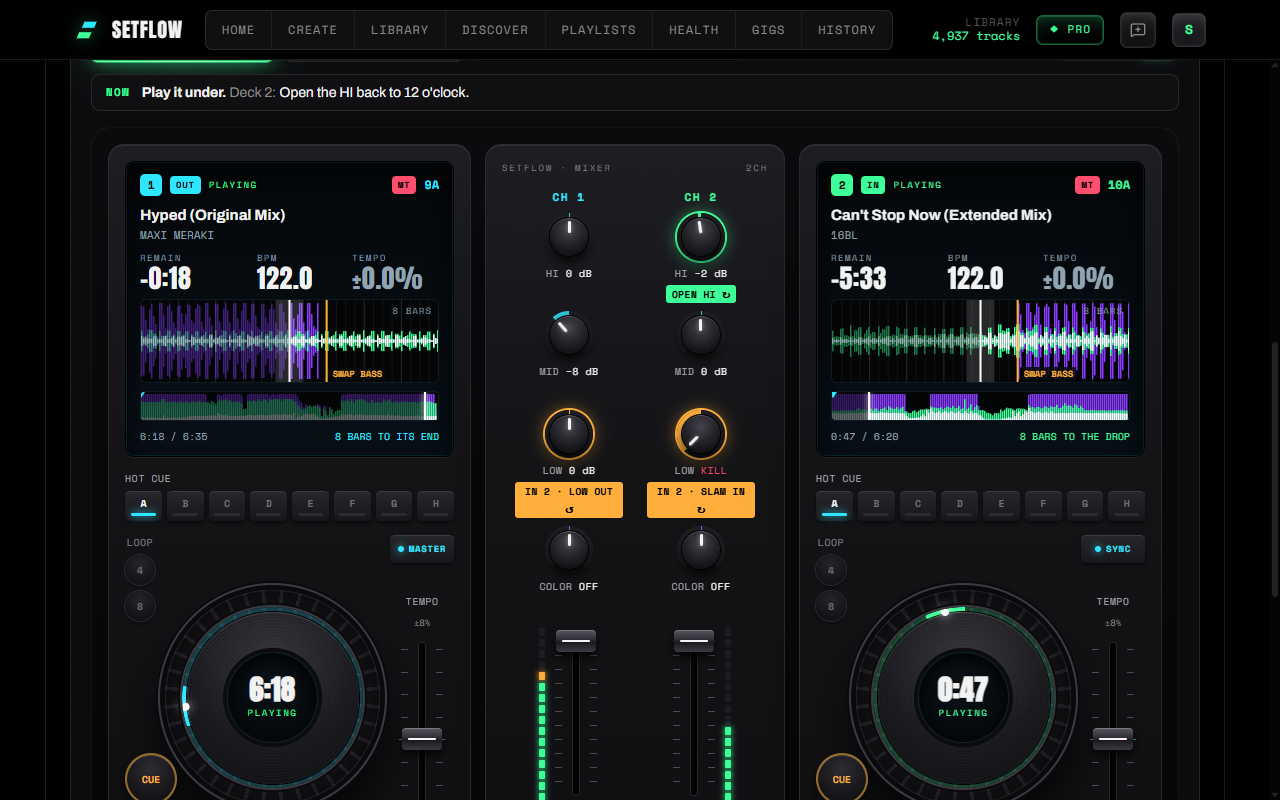
SetFlow's DJ Tutor shows every transition in your set on an on-screen controller. SetFlow picks the bar for each swap from your own files, and the knobs move as the blend plays: the incoming LOW starts killed, then both LOW knobs turn at the swap. A guide under each deck counts you into it, in bars and then beats, and tells you why the swap sits where it does. When a track has no bass until its drop, it tells you to hold the old bass and swap on the drop.
Slow it down to follow the knobs, then press Hear the blend to hear it from the two files in your music folder, beat-matched. Your music never leaves your computer. Learn DJ transitions move by move walks through the DJ Tutor in more detail.
- It's part of Pro. The DJ Tutor is in Smart Mix Points, and a Weekend Pass unlocks it too.
- Hearing it needs a computer with your music folder connected. On a phone the DJ Tutor walks through each transition without sound.
Build a set, open it in the Mix view and switch to DJ Tutor to see where every bass swap lands.
Frequently asked questions
What is a bass swap in DJing?
A bass swap is the moment in a blend when you hand the low end from one track to the other. You start the incoming track with its LOW turned fully down, then on a bar line you turn the outgoing LOW out and the incoming LOW in. Only one bassline plays at full weight at any time, so the mix stays clean.
When should I swap the bass?
On a phrase line, usually where the outgoing track starts winding down. If the new track has no bass until its drop, keep the old bass on and swap on the drop. Always on the first beat of a bar, never halfway through one.
Should the bass swap be instant or gradual?
Both work. An instant swap, both LOW knobs turned at once on the downbeat, is the classic house and techno move and the easiest to get right. A quick cross over a beat or two sounds a little smoother. A slow crossfade of the lows over several bars tends to sound muddy in the middle, so keep it short.
Can I do a bass swap with the filter instead of the EQ?
Yes. Sweep a high-pass filter up on the outgoing track and it takes the bass away, then bring the incoming LOW in on the bar line. It sounds more like an effect than a clean swap, so save it for the transitions that suit it.
Why does my mix go thin or empty at the swap?
Because both lows were down at the same moment: you took the old bass out before the new one came in, or the outgoing track had already lost its bass. Turn both knobs together, and if the outgoing track has gone thin, swap earlier.
How can I practise bass swaps on my own tracks?
SetFlow’s DJ Tutor shows every transition in your set on an on-screen controller and counts you into each swap, in bars and then beats. Hear the blend plays it from your own files on a computer. The DJ Tutor is part of Pro, and a Weekend Pass unlocks it too.
How to Mix Two Songs with Different BPMs (and Get Back to Tempo)
Ready to build better sets?
Import your Rekordbox, Traktor, or Serato library and generate perfectly mixed DJ sets in seconds.
Try SetFlow Free