DJ Phrasing: How to Count Bars and Mix on the Phrase
Your beats are matched, your EQ is clean, and the mix still sounds wrong. Nine times out of ten the problem is phrasing: the new track started at a random bar, so its drop lands in the middle of the old track's section. Here is how phrases work, how to count them, and how to mix on them.

Beats, bars and phrases
Dance music is built from blocks inside blocks:
- A beat is one kick drum in a four-to-the-floor track.
- A bar is 4 beats. The first beat of each bar, the downbeat, feels heavier.
- A phrase is usually 8 bars. Phrases stack into 16- and 32-bar blocks, and producers change something at almost every one of those lines.
Press play and watch one beat, one bar and one phrase go by at club tempo:
Beats make bars, bars make phrases
That holds across house, techno, trance and drum and bass. A typical club track is an intro of 16 or 32 bars, a groove, a breakdown, a build, a drop and an outro, and every section starts on a phrase line.
How to hear a phrase change
You don't need to count every bar of every track. Listen for the signs that a new phrase has started:
- Something new comes in: a hi-hat, a bassline, a vocal, a synth line.
- Something drops out, often the kick, which tells you a breakdown has started.
- A crash cymbal on the downbeat. Producers use it to mark the start of a section.
- A fill or riser in the bar before. Snare rolls and sweeps point at the next phrase line.
- The drop itself, which always lands on a phrase line.
Play a track you know well and tap the table every time you hear one of these. You'll find they arrive every 8 bars, with the bigger changes every 16 or 32.
How to count without losing your place
Counting 128 beats in your head while you also cue a track is hard. Make it easier:
- Count bars, not beats. Say “one” on the downbeat of bar one, “two” on the downbeat of bar two, and feel the other beats.
- Count to 8, then start again. Keep a separate tally of how many 8s have gone by, on your fingers if you need to.
- Reset on every change. When you hear a new element or a crash, you're at one. If your count says five, trust the music, not the count.
- Use the waveform. Breakdowns and drops are easy to see. Count back from them.
What mixing on the phrase means
Mixing on the phrase means you start the incoming track so its phrases line up with the outgoing track's. Both tracks then change at the same moment. The new track's drop lands where the old track would have changed anyway, usually at the start of its outro or its last downbeat, so the switch sounds like the next section of one long record.
Drag the slider to start the next track a few bars early or late, and watch where its drop lands:
On the phrase, or off it
On the phrase · the drop lands where the old track changes anyway
Beatmatching keeps the kicks together. Phrasing keeps the sections together. You need both. If you're still getting the tempo right, start with our guide to mixing songs with different BPMs.
A worked example, in bars
Say the outgoing track (A) and the incoming track (B) are both 124 BPM:
- Track A's outro starts at bar 161 and lasts 32 bars, to bar 192.
- Track B has a 32-bar intro, and its drop lands on its bar 33.
You want B's drop to land as A's outro ends. So you start B on the downbeat of A's bar 161, the first bar of the outro. Count with it: A's bar 161 is B's bar 1, A's 169 is B's 9, and so on, every phrase line shared. Swap the bass on a phrase line near the end, say at A's bar 185 (B's bar 25), and B's drop hits at A's bar 193, exactly where A would have run out.
Want a shorter blend? Start B 16 bars later, on A's bar 177, and play B from its bar 17. The phrases still line up because 16 is a whole number of phrases. Start B on bar 174 and everything is 3 bars off, like the slider above at 3 bars early. Our guide to when to start a DJ transition covers choosing that starting bar, and how to do a bass swap covers the swap itself.
Genres where it's looser
Hip hop, pop and open-format sets don't follow the 8-bar grid as strictly. Verses run 12 or 16 bars, hooks repeat a different number of times, and radio edits cut sections short. Many 90s house records are edits with odd bar counts, or long intros that go on a phrase longer than you expect. With these tracks, mix on the hook or the first line of a verse, keep blends short, and let your ears overrule the count.
Common mistakes
- Starting on any beat. Always start the incoming track on a downbeat, and on a phrase line if you can.
- Counting from the wrong place. Many tracks open with a beat or a bar of silence before the kick. Count from the first kick, not from zero on the clock.
- Trusting the grid over your ears. A beatgrid can be a beat or a bar out. If the drop sounds late, it is.
- Blending too long. A 32-bar blend over two busy tracks is a minute of clutter. 8 or 16 bars is often cleaner.
- Letting the outgoing track hit a breakdown while the incoming one is building. That is the clearest sign the phrases are out.
Use waveforms and phrase markers
You can see phrases. A breakdown is a thin stretch of waveform, a drop is a wall, and a coloured waveform shows the bass dropping out and coming back. Rekordbox can mark phrases for you, and most DJ software can count the beats to your next cue. Use them to check your count, not to replace it: in a club you should be able to hear the next phrase coming. Our posts on seeing your cue points on a waveform and the three-band DJ waveform show what to look for.
Practise phrasing in SetFlow
When you play a track in SetFlow, the player waveform draws faint ticks every 32 bars, alongside your own cue points, when your DJ software exported a beatgrid. Play a track and watch each tick line up with a new element. It is the quickest way to train your ear to expect the change.
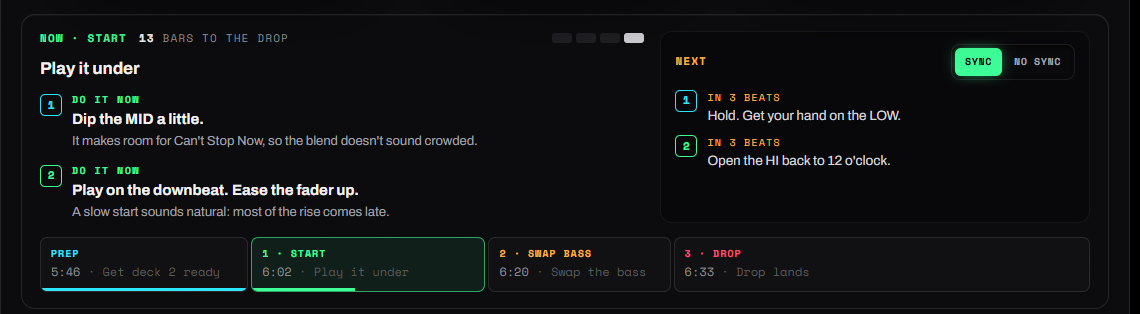
Then open a set in the Mix view and switch to DJ Tutor. Each blend starts on a phrase and runs 8, 16, 32 or 64 bars, and the screen counts the bars down to the bass swap and the drop, on your own tracks, in the order you'll play them. You can move a drop a phrase earlier or later with the arrows on its line and see the whole blend shift with it. On a computer with your music folder connected you can hear the blend too; on a phone it walks through each transition silently. The DJ Tutor is part of Pro, and a Weekend Pass unlocks it.
New to all this? Start with learning to DJ with your own music, read DJ transitions explained, then learn each transition move by move. Or build a set and count along.
Frequently asked questions
What is phrasing in DJing?
Phrasing means starting the next track so that its sections line up with the sections of the track already playing. Dance music is built in blocks of 8, 16 and 32 bars. When the blocks line up, the new track’s drop lands exactly where the old track would have changed anyway, and the mix sounds planned rather than lucky.
How many bars are in a phrase?
In house, techno and drum and bass a phrase is usually 8 bars, and phrases group into bigger blocks of 16 and 32 bars. A bar is 4 beats. So a 32-bar block is 128 beats, which at 124 BPM is just over a minute.
How do I count bars without losing my place?
Count the bars, not the beats: say “one” on the first beat of each bar and keep the other three beats as a feel. Reset to one every time you hear a new element come in or a crash cymbal, because that is almost always the start of a phrase. Waveforms with phrase markers help you check yourself.
Is beatmatching enough without phrasing?
No. Beatmatched but off the phrase, the two tracks are in time but they change at different moments: a breakdown arrives halfway through the other track’s build, or the drop lands in the middle of a section. The crowd hears it as a clash even when the beats are perfect.
Do all genres use 32-bar phrases?
Most four-to-the-floor dance music does. Hip hop, pop and open-format sets are looser: verses can be 12 or 16 bars and edits often cut sections short. There you mix on the hook or a clear vocal line, and you trust your ears over the count.
Can SetFlow count the bars for me?
Yes. The player waveform shows faint ticks every 32 bars when your DJ software exported a beatgrid, and in the Mix view the DJ Tutor starts each blend on a phrase and counts the bars down to the bass swap and the drop on your own tracks. The DJ Tutor is part of Pro, and a Weekend Pass unlocks it too.
DJ Transitions: 6 Ways to Mix Between Tracks (Step by Step)
Ready to build better sets?
Import your Rekordbox, Traktor, or Serato library and generate perfectly mixed DJ sets in seconds.
Try SetFlow Free