How to Build a Harmonically Mixed DJ Set (Step by Step)
A great DJ set isn't a playlist — it's a journey with a shape. Build it well and every transition feels inevitable; the crowd never notices where one track ends and the next begins. This is the end-to-end guide to getting there: how the pieces fit together, and where to go deep on each one.
The Four Things That Make a Set Flow
Whether you sequence by hand or let software help, every smooth set balances the same four factors:
- Harmony — neighbouring tracks are in compatible keys, so melodies and basslines blend instead of clash.
- Tempo — BPM moves in small steps (ideally within a few percent) so transitions never lurch.
- Energy — the set rises and falls on a deliberate arc rather than wandering at random.
- Genre — stylistic shifts are gradual enough that the floor follows you.
Get those four right and the rest is taste. The steps below walk the workflow in order — each links to a deep-dive guide when you want more.
Step 1: Tag Your Library Properly
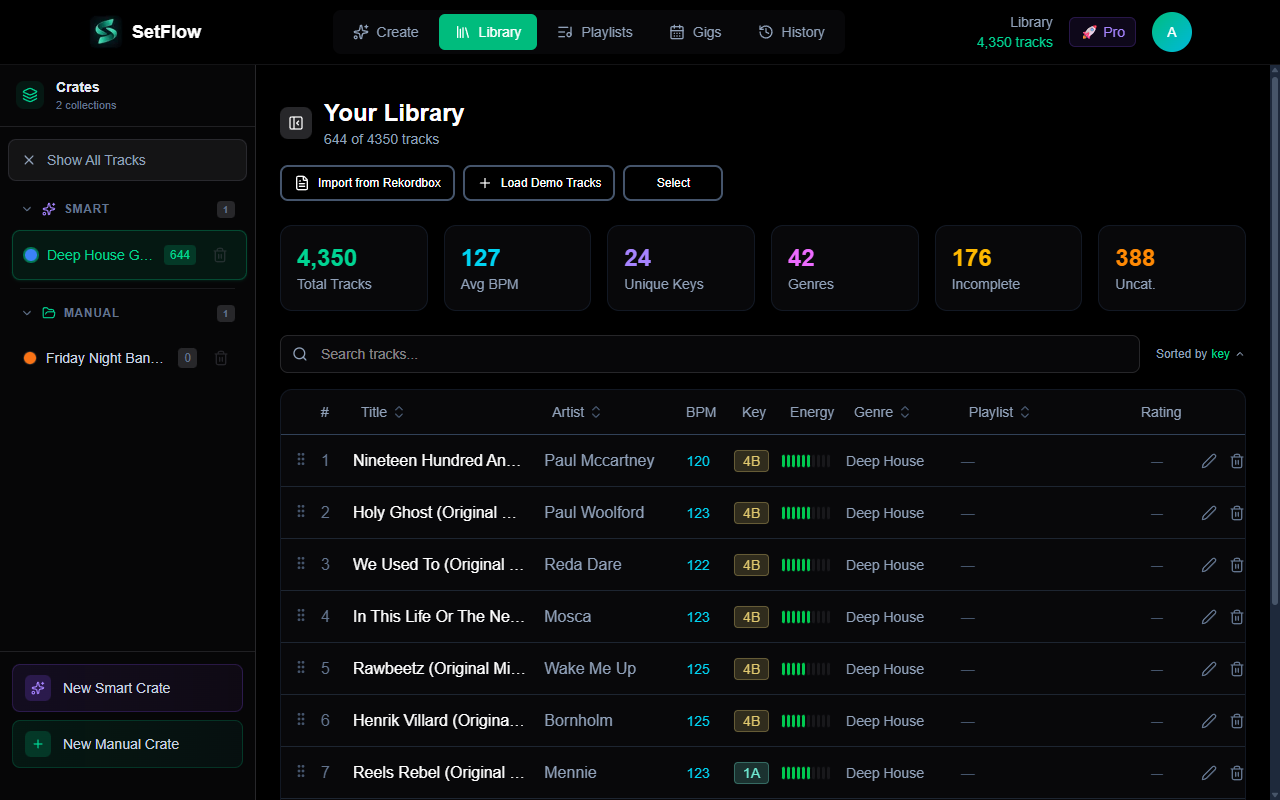
Everything downstream depends on clean metadata. Before you build anything, make sure every track has an accurate BPM, key, and genre, plus ratings and comments that capture your own read on it. Our complete guide to tagging tracks in Rekordbox covers exactly what to tag and why each field matters — and the same principles apply in Serato and Traktor. Already sitting on a messy library? SetFlow can fix your genres and artists for you instead of tagging them all by hand.
Step 2: Get Everything Into One Place
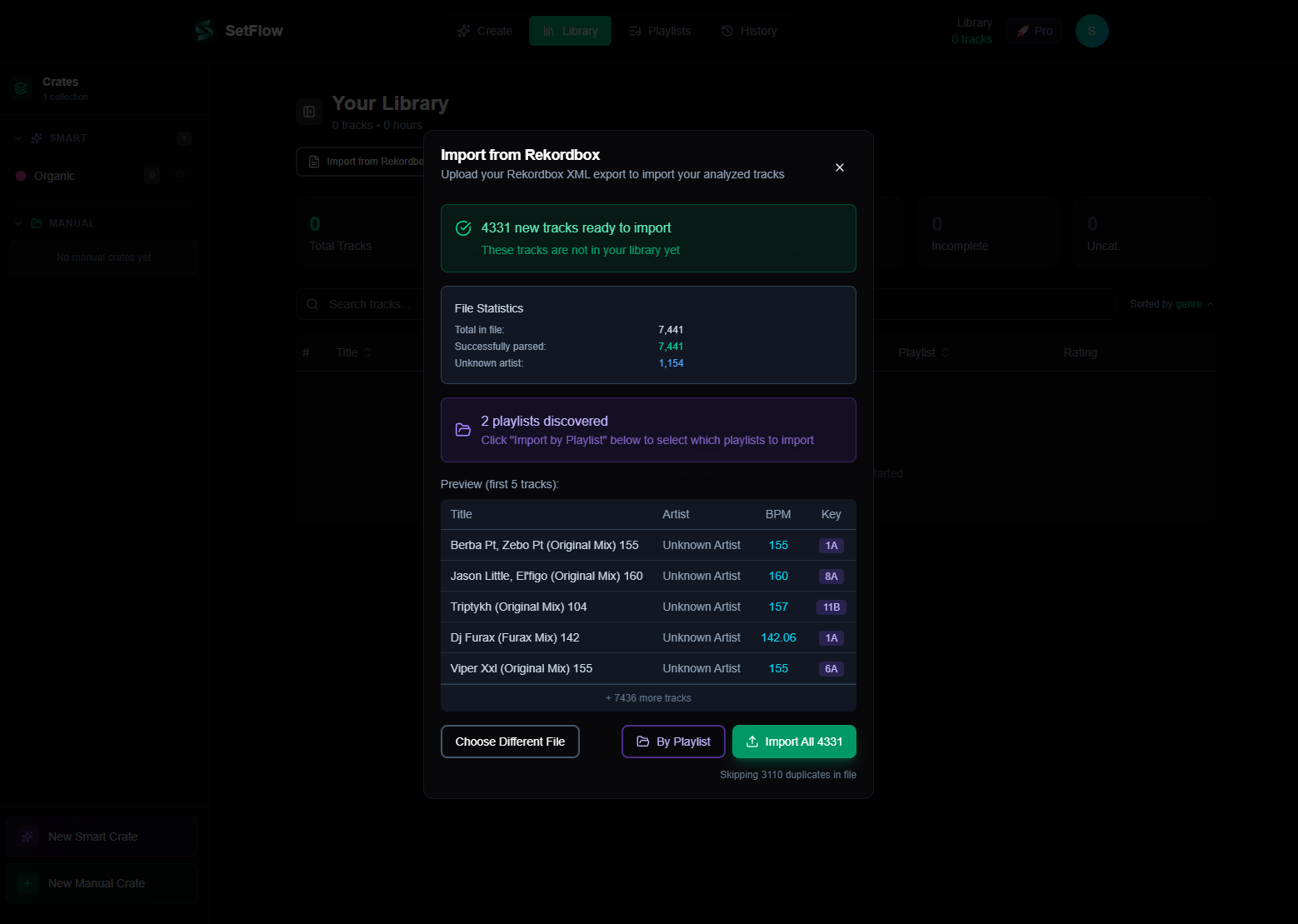
You can't mix a library you can't see. SetFlow imports your collection from whichever software you use — Serato, Traktor, or Rekordbox — with BPM, key, genre, and crate structure intact, so you can plan across your whole catalogue at once and even mix tracks from different software in the same set.
Step 3: Mix in Key with the Camelot Wheel
Harmony is the highest-impact factor in a smooth set. The Camelot wheel maps all 24 keys to a simple numbered system, and four safe moves cover almost every transition you will ever need. If you only read one spoke from this guide, make it the complete guide to harmonic mixing and the Camelot wheel.
Step 4: Shape the Energy Arc
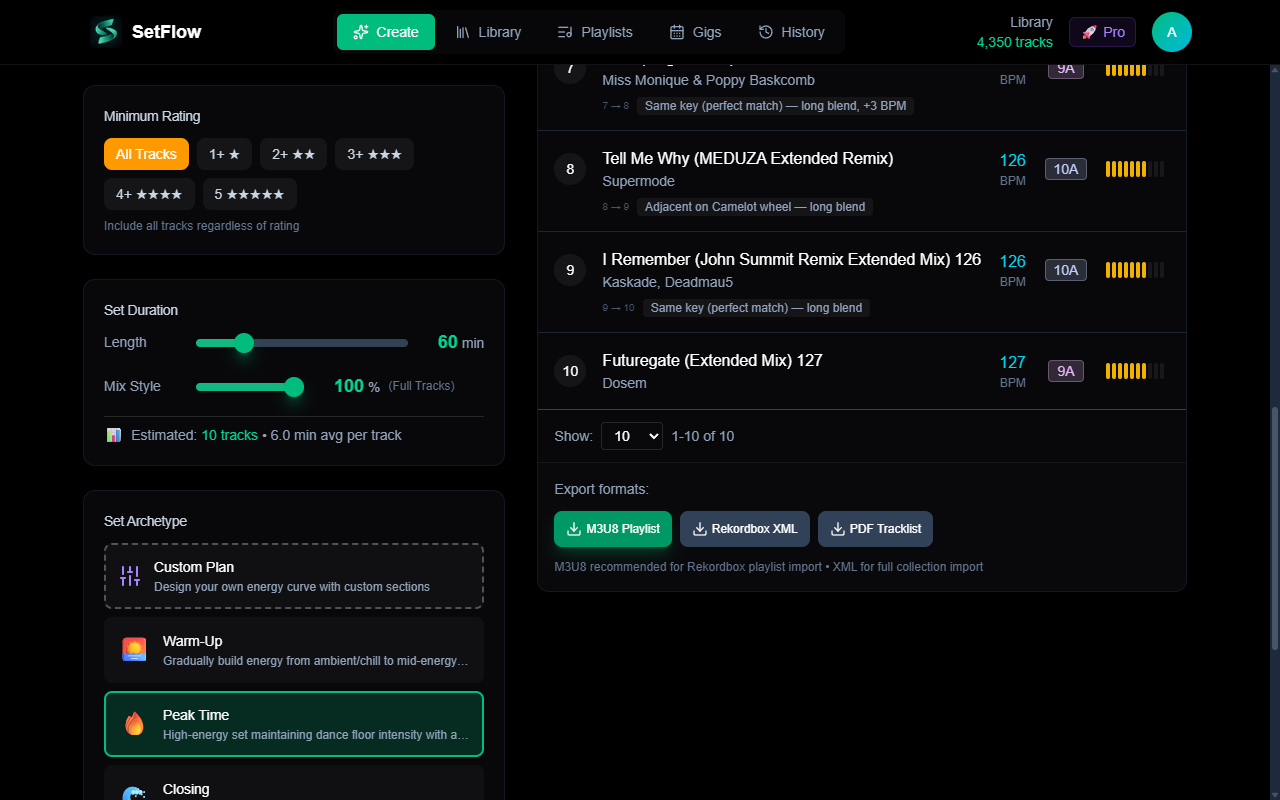
Track selection gets you halfway; structure gets you the rest. Decide where your set builds, peaks, and resolves before you play. Our guide to DJ set energy flow breaks down the five classic set structures and how to plan an arc that fits your slot.
Step 5: Make Sure Your Library Can Deliver
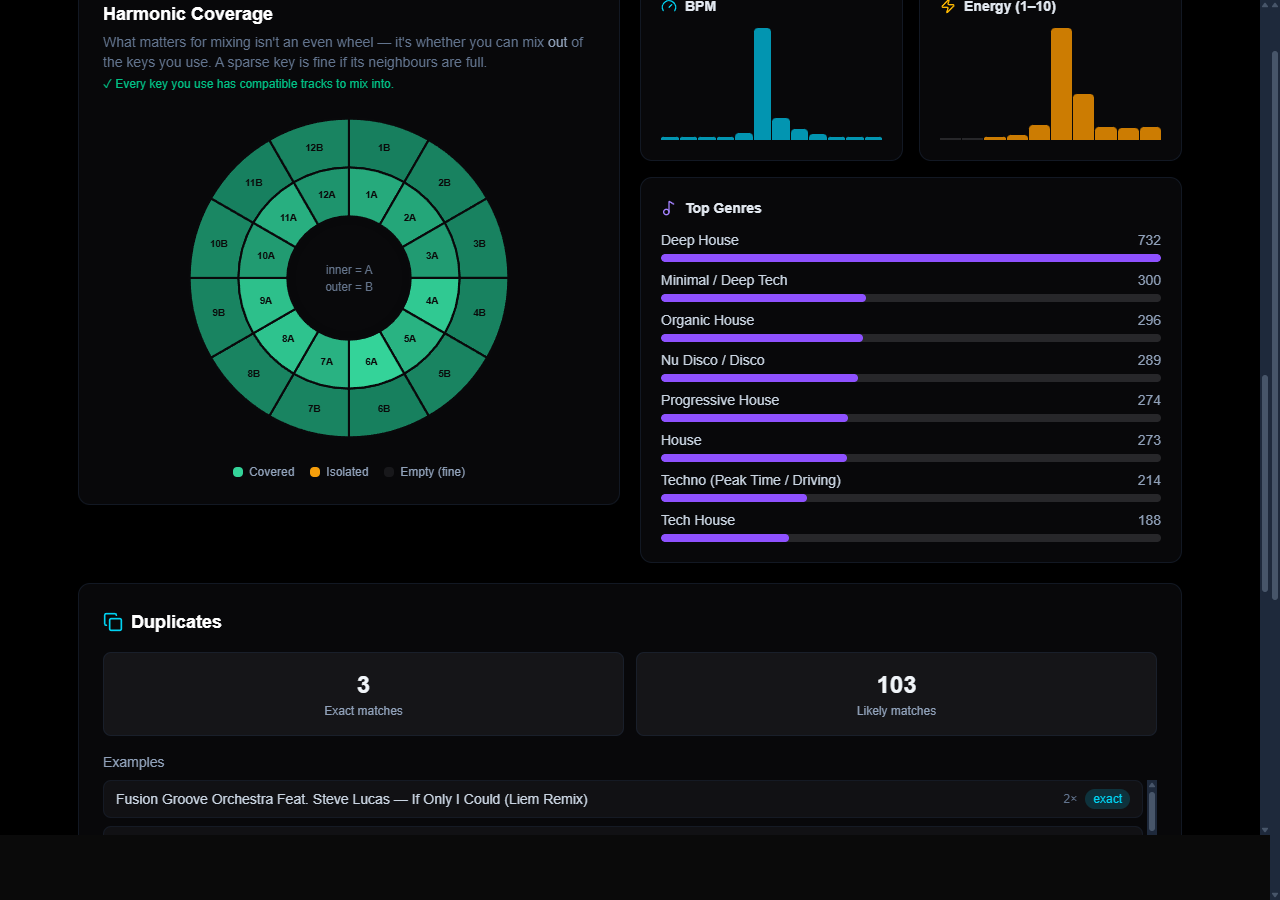
Even a perfect plan fails if your library has gaps — a key with no compatible tracks to mix into, a genre that's thin, or duplicates muddying the pool. SetFlow's Library Health dashboard maps your whole collection and flags exactly where coverage is thin, so you find out before a gig rather than during one.
Step 6: Generate, Refine, Export
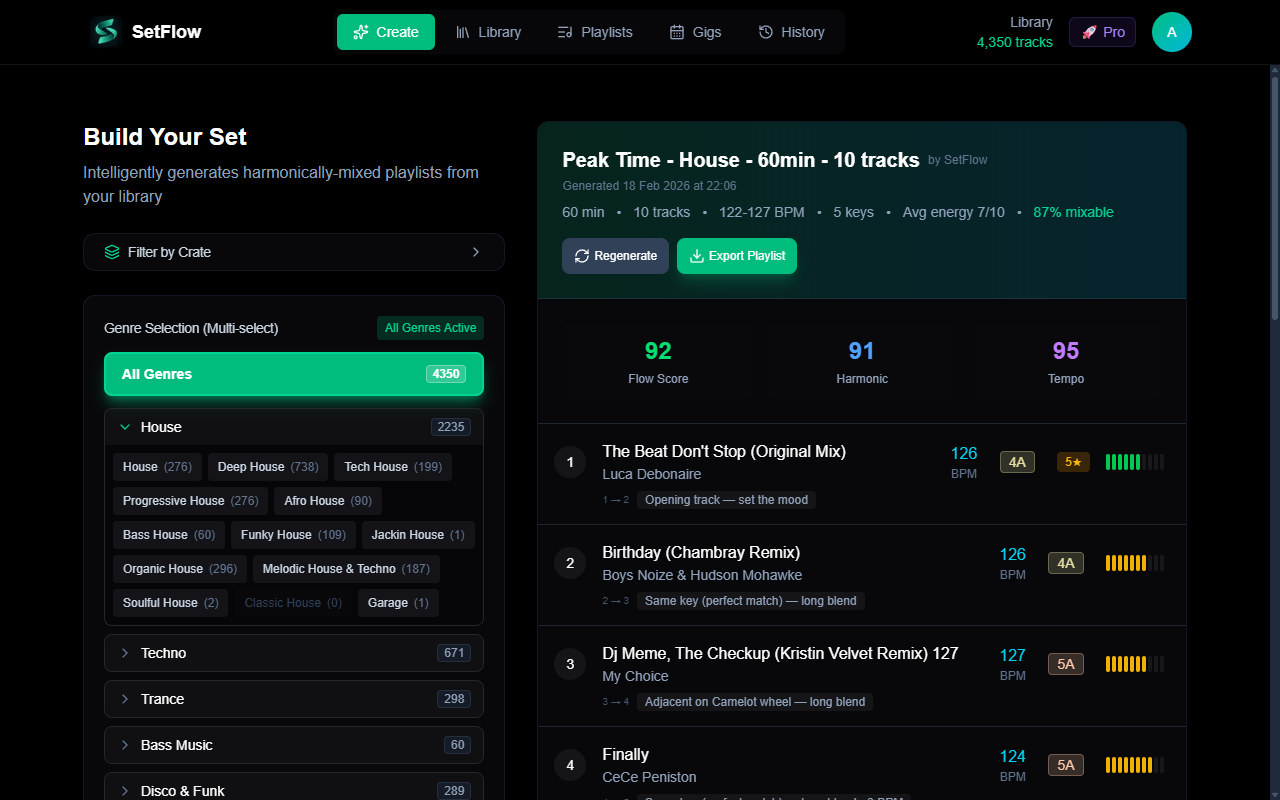
With a tagged, imported library you have two ways to build: sequence by hand using the principles above, or let SetFlow do the heavy lifting. It scores thousands of possible orderings on all four factors at once and hands you the smoothest sequence in seconds — which you can reshape, lock favourite tracks into position, and export straight back to your DJ software. Try it free and build your first set in a couple of minutes.
Wondering whether that counts as “AI”? It doesn't — and that's deliberate. Here's how SetFlow's set generator actually works and why a transparent algorithm beats a black box for DJing.
Frequently Asked Questions
What makes a DJ set "harmonically mixed"?
A harmonically mixed set sequences tracks so neighbouring keys are compatible — using the Camelot wheel, that means staying in key, moving one step, or switching the relative major/minor. Combined with smooth tempo changes and a deliberate energy arc, it makes a set feel like one continuous piece of music rather than a stack of songs.
Do I need music theory to mix harmonically?
No. The Camelot wheel turns 24 musical keys into a simple clock of numbers and letters, so you mix by matching codes (8A, 9A, 8B) instead of reading notation. Tools like SetFlow go further and pick compatible tracks for you automatically.
What do I need before I can build a set?
Tracks with accurate BPM, key, and genre tags. Analyse and tag your library in Rekordbox, Serato, or Traktor first — that metadata is what every set-building decision is based on. A few missing keys or wrong BPMs are the most common reason a set feels off.
How long should a DJ set be?
It depends on your slot, but a rough rule is one track every six minutes — about 15 tracks in a 90-minute set. What matters more than length is the energy arc: where you build, where you peak, and where you let the floor breathe.
Can SetFlow build a harmonically mixed set automatically?
Yes. Import your library, choose an energy profile and length, and SetFlow scores thousands of possible track orderings on harmonic compatibility, tempo, energy, and genre to find the smoothest sequence — then you refine it and export to your DJ software.
Get the Camelot cheat sheet
A one-page printable of all 24 keys, compatible moves, and energy jumps — handy next to the decks.
One email with your download. No newsletter, no spam.
Ready to build better sets?
Import your Rekordbox, Traktor, or Serato library and generate perfectly mixed DJ sets in seconds.
Try SetFlow Free