How to Build Energy in a DJ Set: 5 Structures That Work
You can have the best tracks in the world and still play a flat, forgettable set. Energy flow is the invisible architecture that makes a DJ set feel intentional — and the dancefloor responds to arc, not individual songs.
Why Energy Flow Matters More Than Track Selection
Energy flow is the arc of intensity across your set — when you build tension, when you release it, when you peak, and when you let the floor breathe. It matters more than track selection because crowds respond to the shape of a night, not to individual songs.
Every DJ has been there: you played great tracks all night but the set just didn't feel right. The crowd drifted. The peaks didn't land. The problem usually isn't the tracks — it's the structure.
Energy flow is the shape of your set over time. It's the arc from the first track to the last — when you build tension, when you release it, when you peak, and when you let the floor breathe. A well-structured set with average tracks will always outperform a random sequence of bangers, because humans respond to narrative. We want tension and release. We want a journey.
The 5 Classic Set Structures
Almost every DJ set follows one of five energy shapes: the Journey, Peak Time, Warm-Up, Cool-Down, or Chill. The right one depends on your time slot, the venue, and what's expected of you.
1. The Journey
Energy arc: Start 3–4 → Build to 5–7 → Peak at 8–10 → Wind down 5–6 → Close 3–4
The complete emotional arc. You ease the crowd in, build through the middle, hit one or two peaks, then bring the energy back down for a satisfying close. This is the structure for headline sets, 2+ hour slots, and any gig where you own the room from start to finish.
When to use it: Headline slots, club residencies, 2–4 hour sets, events where you're the main act.
2. Peak Time
Energy arc: Consistent 8–10 throughout
No warm-up, no wind-down — just relentless energy from the first beat to the last. This structure works when the crowd is already warmed up and expecting maximum intensity. The challenge is maintaining variety at high energy without sounding repetitive.
When to use it: Main room slots, festival mainstages, 60–90 minute sets after another DJ has warmed up the floor.
3. Warm-Up
Energy arc: Start 2–3 → Gradual rise → End 7–8
Your job is to set the tone and hand over a warmed-up crowd to the next DJ. Start low and ambient, gradually introduce rhythm and melody, and build to a level that the next DJ can pick up from. The cardinal sin of a warm-up set is peaking too early — you leave the headliner nowhere to go.
When to use it: Opening slot, first DJ of the night, playing before a headliner.
4. Cool-Down
Energy arc: Start 8–9 → Gradual descent → End 2–3
The mirror of a warm-up. You pick up the energy from the previous DJ and gently bring the crowd down. This is about controlled deceleration — dropping too fast feels abrupt, but taking too long loses the audience.
When to use it: Closing sets, after the headliner, winding down the night.
5. Chill
Energy arc: Steady 3–4 throughout
Consistent low-energy vibes. No dramatic builds, no peaks — just a steady, pleasant atmosphere. The skill here is maintaining interest and flow without the crutch of energy escalation.
When to use it: Lounge areas, afterparties, poolside sessions, background music at events.
Energy Levels at a Glance
How Energy is Encoded in Your Tracks
To build an energy arc, you need to know how much energy each track carries. But energy isn't a single number — it's a combination of factors:
- BPM — Faster tracks generally feel higher energy, but it's not linear. A 128 BPM melodic house track feels very different from 128 BPM peak-time techno. BPM is a proxy for energy, not the whole picture.
- Genre — Genres carry inherent energy expectations. Ambient and deep house sit low on the scale. Tech house and progressive occupy the middle. Peak-time techno and hard techno live at the top.
- Arrangement and production — Stripped-back, minimal arrangements feel lower energy than dense, layered productions — even at the same BPM and genre.
- Your assessment — Ultimately, you know your tracks best. Using Rekordbox's rating and comments fields to mark energy levels gives you (and SetFlow) the most accurate picture.
Building Energy: The Toolkit
To build energy in a DJ set: raise the BPM gradually (2–4 per transition), escalate through genre families, use minor-to-major key switches to brighten the mood, and hold your biggest tracks for the final third. Each technique in detail:
BPM Progression
Gradually increasing BPM by 2–4 per transition is the most reliable way to build energy. Going from 122 to 130 over eight tracks creates a natural sense of acceleration that the crowd feels without consciously noticing. Avoid large BPM jumps — anything over 8% difference between tracks sounds jarring. If you're not sure what tempo lane a genre lives in, our BPM by genre tempo chart maps them all.
Genre Escalation
Moving through genre families is a powerful energy tool. A typical escalation might be: deep house → house → tech house → techno. Each genre shift raises the intensity ceiling. The reverse works for winding down.
Key Changes for Mood Shifts
As covered in our harmonic mixing guide, switching between minor (A) and major (B) keys at the same Camelot number changes the emotional tone without breaking harmonic compatibility. Minor keys feel darker and more driving. Major keys feel brighter and more uplifting. Use this to push energy in either direction.
Track Ratings as Energy Markers
Use your track ratings strategically. If you rate tracks partly on energy (5 stars for peak-time weapons, 1–2 stars for warm-up tracks), you can quickly scan your library to find tracks that fit each phase of your energy arc.
Common Energy Mistakes
The most common energy mistake is peaking too early — playing your biggest tracks in the first half and leaving nowhere to go. The full list of pitfalls that trip up DJs at every level:
- Peaking too early — Playing your biggest tracks in the first 30 minutes leaves you nowhere to go. If you peak in the first third of your set, the remaining two-thirds will feel like a slow decline no matter what you play.
- No recovery after peaks — Peak moments need contrast to hit hard. If you play ten bangers in a row, they stop feeling like bangers. Drop the energy for 2–3 tracks after a peak, then build again. The second peak will hit even harder.
- Monotone energy — Sets where every track is at the same energy level — whether that's a consistent 5 or a consistent 9 — feel flat and boring. Contrast creates excitement. Even peak-time sets need subtle energy variation.
- Ignoring your time slot — Opening a warm-up slot with bangers doesn't make you look good — it makes the headliner's job harder and signals that you don't understand the role. Read the room, respect the slot, and play to the structure your position demands.
Planning Your Energy Arc
A practical approach to energy planning is thinking in thirds:
- First third — Establish the vibe. Set the genre, the tempo range, and the mood. This is where you win or lose the audience's attention. Choose tracks carefully — the first 3 tracks set expectations for everything that follows.
- Middle third — Build and develop. This is where the energy arc takes shape. Introduce harder tracks, raise BPM gradually, tighten your transitions. The crowd should feel momentum building without being able to pinpoint when it started.
- Final third — Deliver and resolve. Your peak moment(s) happen here. And just as the first 3 tracks set the tone, the last 3 tracks determine how the set is remembered. End with intention, not because you ran out of time.
Map specific energy levels to track positions before you play. If you have a 90-minute set (roughly 15 tracks at 6 minutes each), decide in advance which positions should be at energy level 4, which at 7, and which at 9. Then select tracks that match those targets.
How SetFlow Shapes Energy Automatically
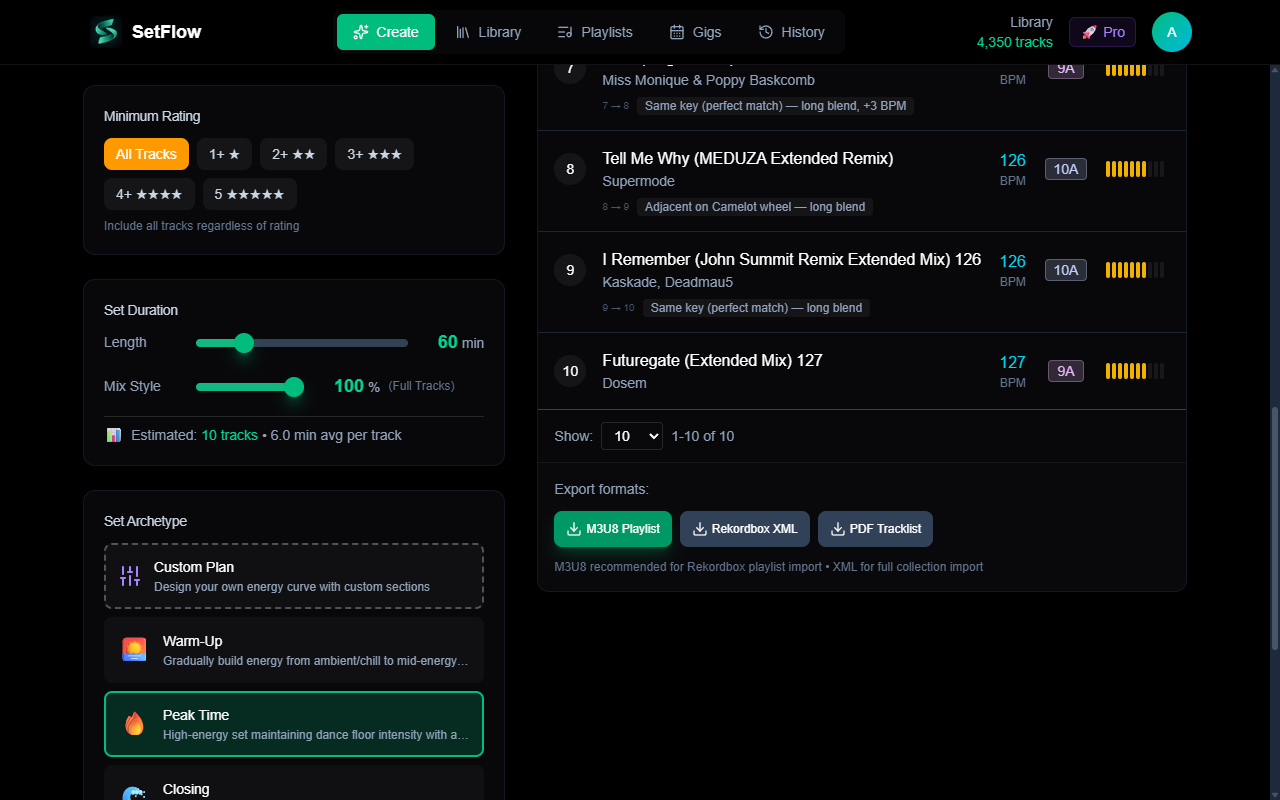
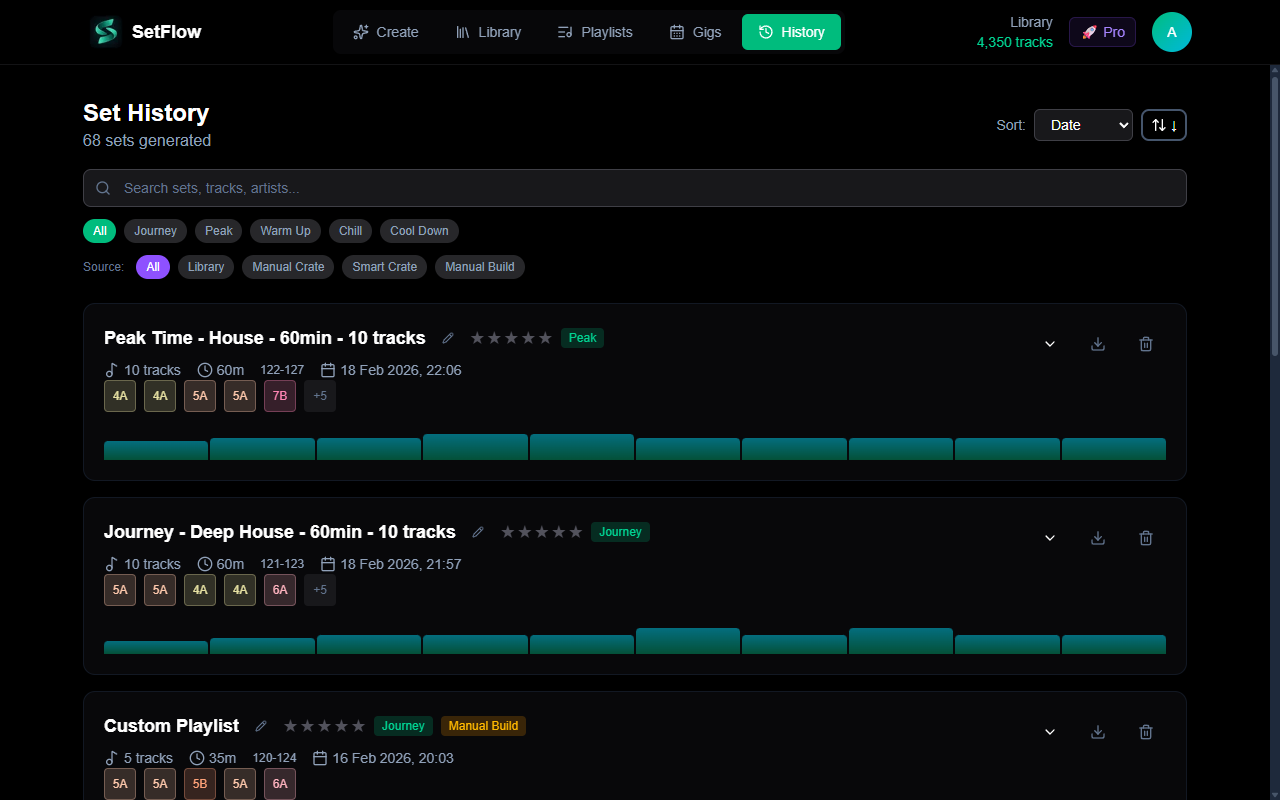
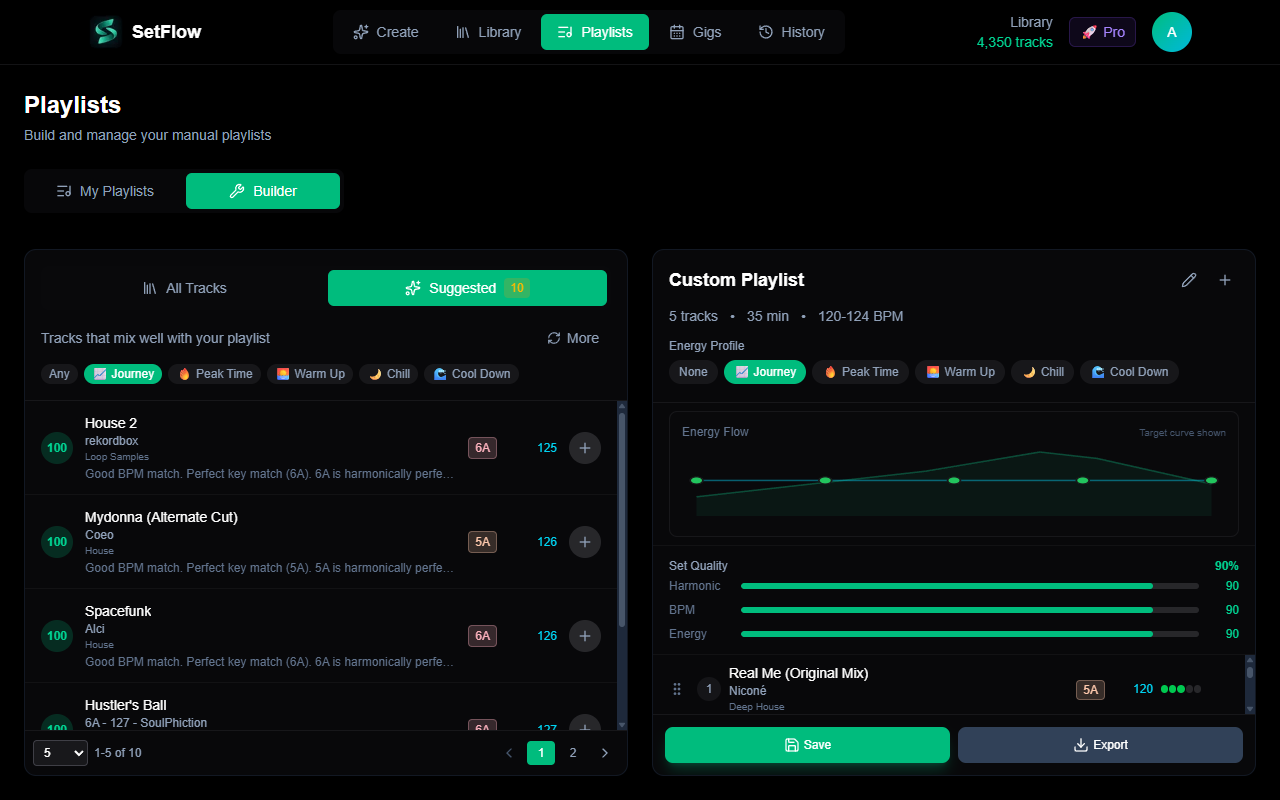
SetFlow has five built-in energy presets that match the classic structures described above: Journey, Peak Time, Warm-Up, Cool-Down, and Chill. When you generate a set, you choose the preset that fits your gig, and the algorithm matches tracks to that energy curve automatically.
Energy flow accounts for 15% of every transition score. Combined with harmonic compatibility (35%), BPM matching (25%), and genre compatibility (15%), the algorithm balances all four factors simultaneously — something that's extremely time-consuming to do manually.
Pro subscribers also get the Set Planning Canvas — a custom energy curve editor where you can draw your own arc, placing peaks and valleys exactly where you want them. This means you're not limited to the five presets. You can design energy shapes for specific venues, time slots, or creative visions, and SetFlow will find the track sequence that best fits your curve.
The algorithm works best when your tracks have accurate energy data. Make sure your Rekordbox library is well tagged — BPM, genre, ratings, and comments all feed into energy derivation. Energy is one piece of the bigger picture — see the full guide to building a harmonically mixed DJ set.
Frequently Asked Questions
How do I structure a DJ set?
Pick one of five classic shapes for your slot: the Journey (build and release over a long set), Peak Time (relentless high energy), Warm-Up (start low, hand over warm), Cool-Down (bring it back down), or Chill (steady and low). Then map energy levels to track positions before you play.
What is energy flow in a DJ set?
Energy flow is the arc of intensity across your set over time — when you build tension, when you release it, when you peak, and when you let the floor breathe. A well-shaped arc with average tracks beats a random run of bangers, because crowds respond to narrative, not individual songs.
How do you build energy in a DJ set?
Raise BPM gradually (2–4 per transition), escalate through genre families (deep house → house → tech house → techno), use minor-to-major key switches to brighten the mood, and save your highest-rated tracks for the final third. Above all, avoid peaking too early.
What is the most common DJ energy mistake?
Peaking too early. If you drop your biggest tracks in the first 30 minutes, the rest of the set feels like a slow decline. Keep peaks for the final third, and always leave contrast — ten bangers in a row stop feeling like bangers.
How many tracks are in a DJ set?
It depends on track length and mixing style, but a useful rule is roughly one track every six minutes — about 15 tracks in a 90-minute set. Decide which positions sit at low, mid, and peak energy, then choose tracks that hit those targets.
Ready to build better sets?
Import your Rekordbox, Traktor, or Serato library and generate perfectly mixed DJ sets in seconds.
Try SetFlow Free