Energy Boost Mixing: When to Jump +2 or +7 on the Camelot Wheel
Harmonic mixing has a safe zone: the same key, one step round the Camelot wheel, or the relative major or minor. Stay inside it and nothing clashes. Stay inside it for two hours and the set can sound like one long track. The moves outside the zone, +2, +7, the diagonal and the same-root switch, are how DJs change key on purpose. Here is what each one does, when it works, and how to have SetFlow plan them into a set.
The safe zone, and why to leave it
From 8A (A minor) the classic moves are 8A again, 7A or 9A, and 8B. Each shares all or all but one of its notes with the track before, so you can hold the two together for 32 bars and it sounds like one piece of music. That is the point of harmonic mixing with the Camelot wheel, and it should be most of any set.
The cost is that nothing ever sounds new. A key change the room can hear is one of the few ways to raise the energy without raising the tempo, and one of the few ways out of a run of tracks that all sit in the same corner of the wheel.
+2: up a tone
Two steps clockwise on the same ring: 8A to 10A, A minor to B minor. Everything in the new track sits a whole tone higher. It is the gentler of the two lifts and the one to reach for on the way up to a peak. The way back down, 10A to 8A, is not the same move: it sags, so plan it as a one-way step.
+7: up a semitone
Seven steps clockwise on the same ring: 8A to 3A, A minor to B flat minor. This is the key change from the last chorus of a pop song, and a dancefloor hears it the same way. It is the biggest lift you have and the two keys share almost nothing, so it needs the least overlap of all: a cut on the phrase, or a few bars over drums.
The diagonal
One step round and across to the other ring: 8A to 9B or 8A to 7B. Only one note of the scale changes, so it is the mildest move here, and it flips the mood between minor and major on the way. Good for turning a dark stretch brighter without anyone noticing how.
Same root, other mode
8A to 11B is A minor to A major; 8B to 5A is C major to C minor. The bass note stays where it was and the mood changes over it. On the wheel the two look far apart, which is why this one is easy to miss: from a minor key it is three steps clockwise and across, from a major key three steps back and across.
Three rules for using them
- Keep them rare. One in every four mixes is plenty. A lift only reads as a lift against a stretch that stayed put.
- Lift when the energy is holding or rising. A key jump up into a quieter track pulls two ways at once. Save +2 and +7 for a build or the peak.
- Keep the blend short. Eight bars or less, a cut, or a swap over a breakdown. Held for 32 bars these keys sound sour. More on that in when to start a transition.
Plan them into a set with SetFlow
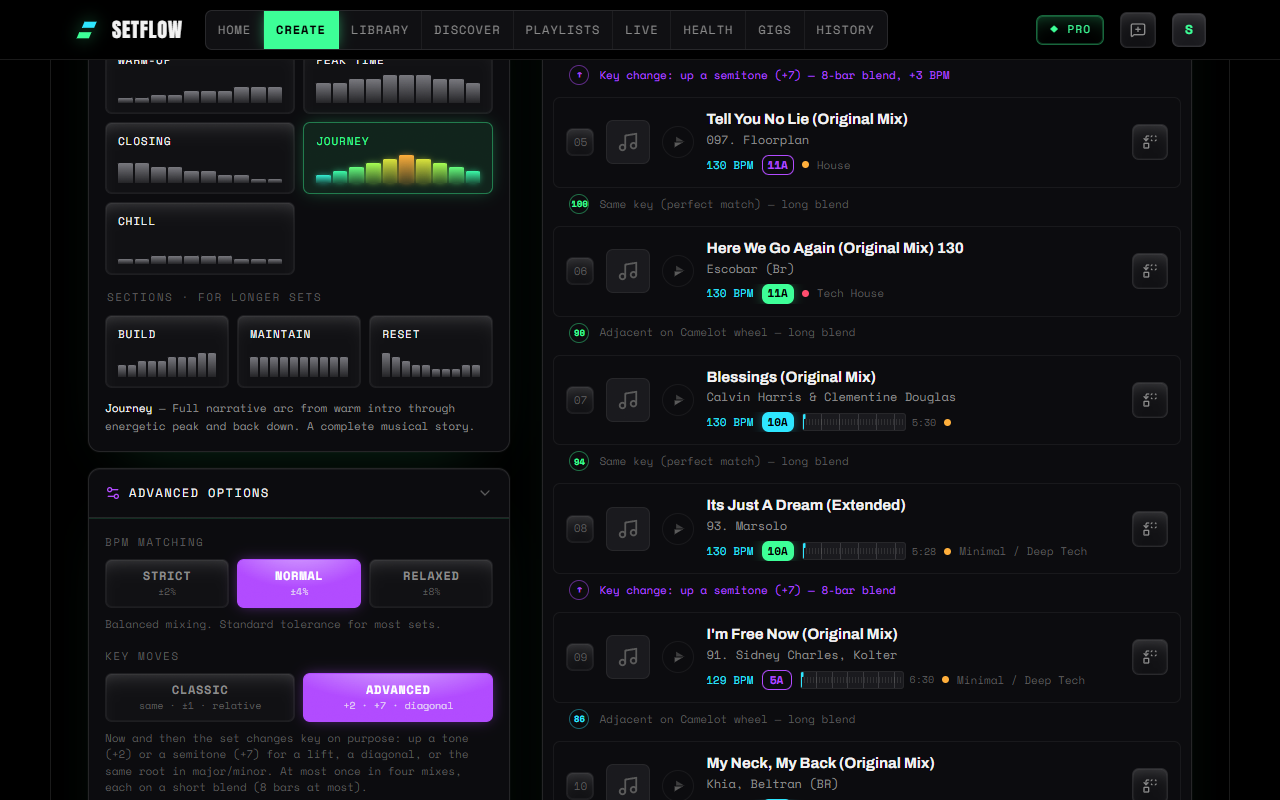
On Create, open Advanced options and set Key moves to Advanced. Generate a set as usual. Most mixes still stay in key; now and then the set changes key on purpose, following the three rules above:
- At most one deliberate key change in any four mixes.
- A tone or a semitone up only where the track coming in has as much energy as the one going out, or more.
- Each one gets a short blend of its own, 8 bars at most, whatever blend length the rest of the set uses. The Mix view plays it at that length.
The set score counts these as clean mixes, so a set isn't marked down for a key change you asked for. A small library gains the most: with more keys to move to, there are more tracks that fit each slot. Classic stays the default, and SetFlow remembers your choice on each device.
Try SetFlow free for 7 days. Import your Rekordbox, Traktor or Serato library and generate a set on Create. See the changelog for everything else that's new, or look up any key on the Camelot wheel.
Frequently Asked Questions
What is energy boost mixing?
Energy boost mixing is changing key upwards on purpose to lift the room: up a whole tone, which is +2 on the Camelot wheel (8A to 10A), or up a semitone, which is +7 (8A to 3A). The new track sounds higher and brighter than the one before it, so the energy seems to jump even at the same tempo.
What does +7 mean on the Camelot wheel?
Seven steps clockwise on the same ring, which is one semitone up. From 8A (A minor) that is 3A (B flat minor); from 8B (C major) it is 3B (D flat major). It is the strongest key lift a DJ has, and the two keys share very few notes, so it works as a cut or a very short blend.
Is +2 or +7 the better energy boost?
They do different jobs. +2 (a tone up) is the gentler lift and suits a build towards the peak. +7 (a semitone up) is the bigger jolt, the pop key change, and suits the moment you want the room to notice. Either way, use it once in a while: back to back, they stop sounding like a lift and start sounding out of key.
Do energy boost key changes clash?
Held together for long, yes. Keys a tone or a semitone apart share too few notes for a 32-bar blend. Keep the two tracks together for 8 bars or less, cut on a phrase, or swap over a breakdown or a drum-only section, and you hear the lift without the clash.
What is a diagonal mix on the Camelot wheel?
One step round the wheel and across to the other ring at once: 8A to 9B or 8A to 7B. Only one note of the scale changes, so it is the mildest move outside the classic ones, and it changes the mood between minor and major at the same time.
Can SetFlow plan sets with these key changes?
Yes. On Create, open Advanced options and set Key moves to Advanced. The set then makes a deliberate key change at most once in any four mixes: a tone or a semitone up where the energy is holding or rising, a diagonal, or the same root in major or minor. Each one is given a short blend, and the set score counts it as a clean mix. It is on every plan.
Get the Camelot cheat sheet
A one-page printable of all 24 keys, compatible moves, and energy jumps — handy next to the decks.
One email with your download. No newsletter, no spam.
Ready to build better sets?
Import your Rekordbox, Traktor, or Serato library and generate perfectly mixed DJ sets in seconds.
Try SetFlow Free