What Makes a Good DJ Set? The 5 Things Every Crowd Hears
Ask a room of DJs what makes a set good and you'll hear the same few things, in different words. None of them is about a single track. They're about how the tracks sit together: in key, in tempo, in energy, in genre. Here are the five things a crowd hears, what to aim for in each, and how SetFlow now checks every set against them.
1. Keys that sit together
A key clash is the one mistake a dancefloor hears even when nobody could tell you why. Two tracks in keys that don't agree sound sour for the whole blend. The safe moves on the Camelot wheel are the same key, one step round the wheel, or the relative major or minor; two steps up, on the same ring, is the classic lift for a peak. Use that lift sparingly: twice in four tracks and it stops feeling like a lift.
2. A tempo with a direction
Every room has a tempo it expects: a house night sits around 122 to 126 BPM, peak-time techno higher (the tempo chart by genre has the ranges). Start near the low end, push up into the peak, and settle after it. What you want to avoid is a set whose tempo wanders: 124, 127, 125, 128, 124. Every one of those moves is a pitch change you have to ride, and none of them takes the room anywhere. A couple of changes of direction an hour is plenty.
3. Energy that tells a story
Each kind of slot has a shape: a warm-up climbs, a peak-time set holds high, a journey rises and comes back down, a closing set winds down. Follow it a step at a time, one or two levels per track, so the room never feels a jolt. And let the peak breathe: four to six tracks at the very top, then one a level lower, then lift again. Peaks that come in waves keep a room with you; fifteen tracks flat out wear it out. More on the shapes that work in how to build energy in a DJ set.
4. Genres in blocks
A set can travel a long way, deep house to techno in an evening, as long as it travels. Stay in a genre for a few tracks, move to a neighbour before a stranger, and change family (house to techno, techno to trance) no more than about once an hour. The giveaway of a playlist is the back and forth: Tech House, House, Tech House, House.
5. The right tracks
Club mixes, not radio edits: a three-minute edit plays out before a blend has time to breathe. And never the same song twice. That sounds obvious, but a library that's been downloaded into for years often holds the same track twice under different tags (“Unknown Artist — 62. Luke Dean - Get Busy” next to Luke Dean’s own copy), and it's easy to play both.
How SetFlow scores your set
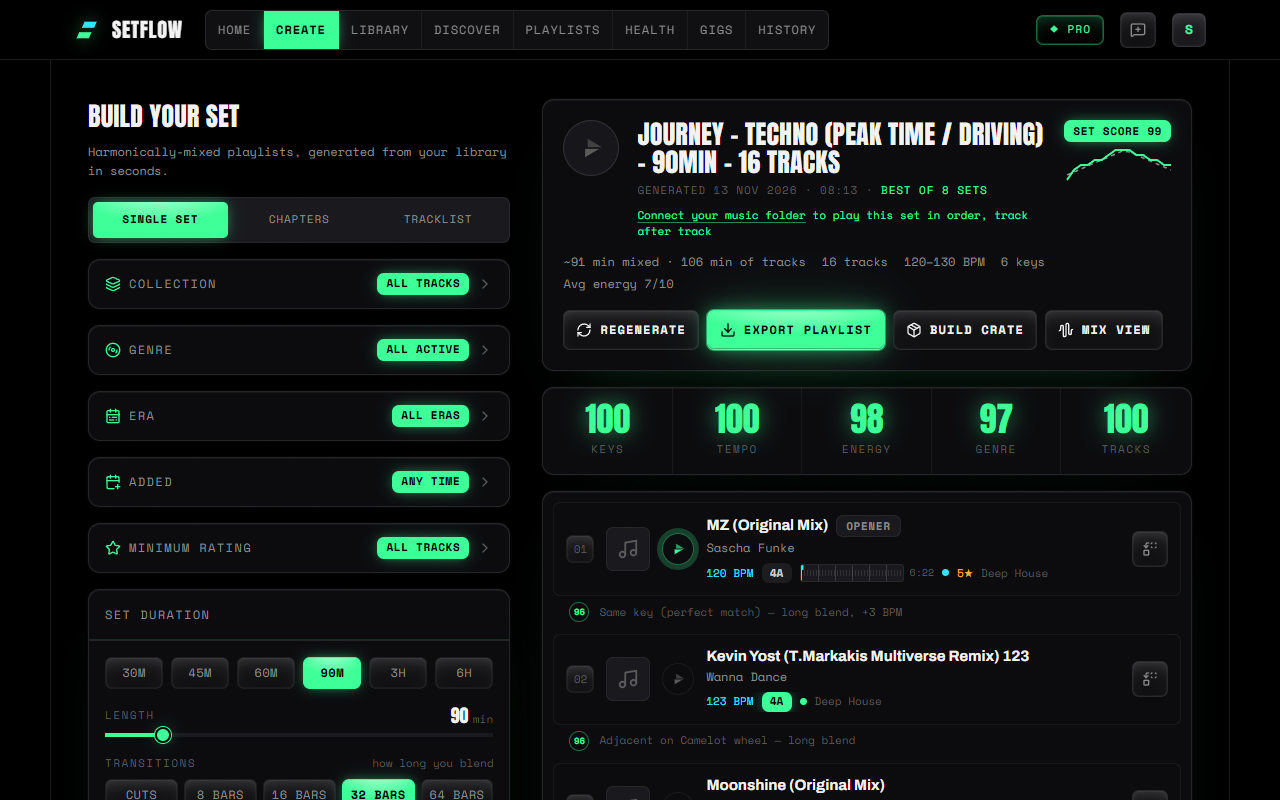
Every set you build on SetFlow's Create page now comes with a set score out of 100:
- Marked on all five. Keys, tempo, energy, genre and tracks each get a score, and the set score weighs them together.
- It says why. Under the score, the one thing that cost the set the most points, such as “The tempo changes direction 4 times an hour”.
- Dug from your library. SetFlow digs through your library for the tracks that mix best together, tries them more than one way and keeps the strongest set. You can watch it dig: each try's score lands as its opening tracks roll in. A whole night in Set Chapters gets the same dig.
- Built with a shape. Each set's tempo follows its energy, its genres move in blocks, and its peaks take a breath, so the set you get is a set with a plan.
- Honest about energy. If most of your library's energy is still a guess from genre and tempo, the score leaves energy out rather than marking you down for it. Measure it from your music and it counts.
Build a set on the Create page to see it dig, or read what else changed in the changelog.
Frequently Asked Questions
What makes a good DJ set?
Five things a crowd hears, even if it can’t name them: keys that sit together, a tempo that moves with a purpose, energy that rises and falls with the night, genres that change gradually rather than back and forth, and the right tracks: full-length club mixes, never the same song twice.
How often should the tempo change direction in a DJ set?
Rarely. Pick the tempo your room expects and move it on purpose: up into the peak, back down to close. A couple of changes of direction an hour is plenty. Going up and down two or three BPM with every track sounds like a set without a plan, and keeps you riding the pitch fader all night.
How long should the peak of a DJ set last?
Four to six tracks at the very top, then a breather: one track a level lower before you lift again. Fifteen tracks flat out tires a room; peaks that come in waves keep it with you.
Should a DJ set stick to one genre?
It doesn’t have to, but it should move in blocks. Stay in a genre for a few tracks, move to a related one (deep house to house to tech house), and change family, from house to techno for example, no more than about once an hour. Going back and forth between two genres is what makes a set sound like a playlist.
How does SetFlow score a DJ set?
Out of 100, on the five things above: keys, tempo, energy, genre and tracks, with a line saying what cost the most points. SetFlow digs through your library for the tracks that mix best together, tries them more than one way and keeps the set with the best score. When most of a set’s energy is a guess from genre and tempo rather than measured from the audio, energy is left out of the score.
Ready to build better sets?
Import your Rekordbox, Traktor, or Serato library and generate perfectly mixed DJ sets in seconds.
Try SetFlow Free