How to Build a 90s House Set From a Modern DJ Library
A 90s house set is harder to build than it sounds. The records are scattered across your library, the BPMs drift between 118 and 128, and half your collection is tagged “House” with no way to tell a 1994 Strictly Rhythm cut from something released last month. Here is how to pull a decade out of a modern DJ library and get it mixing properly.
Why the decade is the hard part
Genre gets you halfway. Filter to house and you have a few thousand records, most of which are not what you mean by “90s house”. The thing that separates them is the release year, and that is usually the one piece of metadata nobody filters on — not because it is missing, but because most tools never read it.
Both Rekordbox and Traktor store it. Rekordbox keeps a year against each track. Traktor keeps a full release date. If your library came from either, the information is already sitting in your collection file.
Step 1: get the years into your library
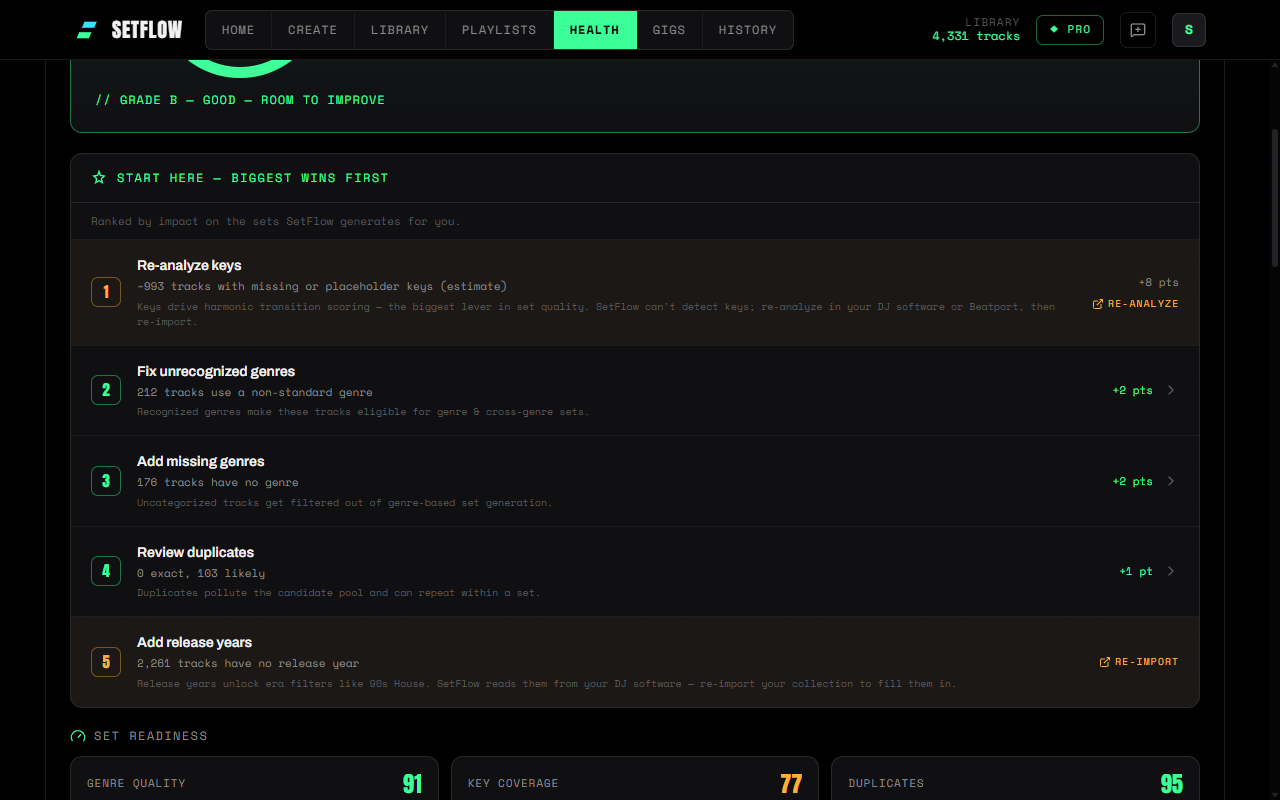
In SetFlow, release years are read at import. Export your collection from your DJ software as you normally would, then import it again from Library → Import. Your existing tracks are updated in place rather than duplicated, so nothing is lost and nothing doubles up.
If you want to check the damage first, Library Health lists how many of your tracks have no release year and links straight to them. It does not count against your Set Readiness score — a blank year is not a mistake you made.
Step 2: narrow to the decade, not just the genre
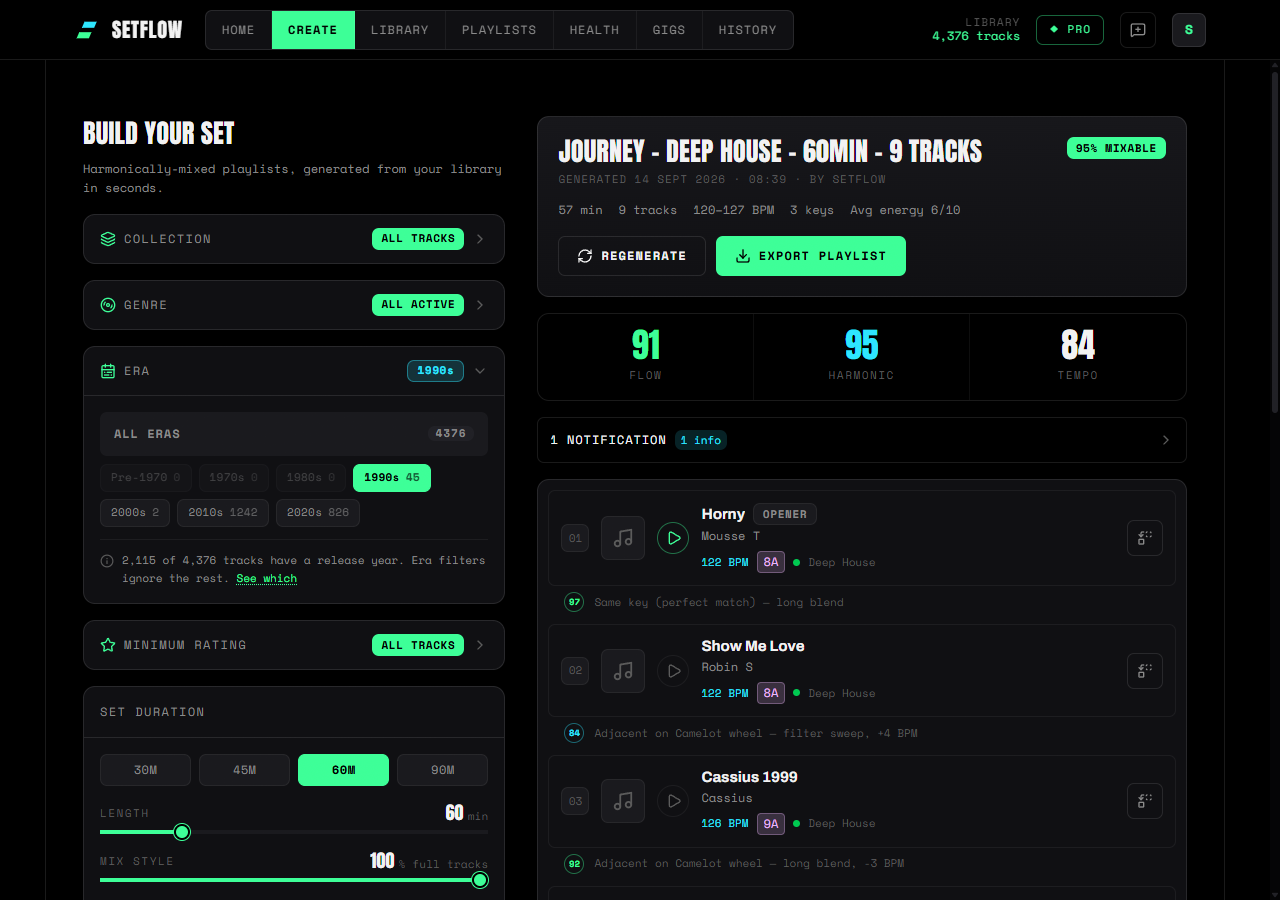
On the Create page, the Era panel sits directly under Genre. Pick the 1990s chip and House together and your candidate pool drops from everything you own to the records you actually mean. Each chip carries a live count measured inside your other filters, so choosing a genre re-counts the decades. That matters more than it sounds: a library can hold 800 tracks from the 2020s and none of them tagged deep house, and the counts will tell you that before you generate rather than after.
One thing worth knowing: a track with no release year cannot belong to a decade, so an era filter skips it. The panel tells you how many tracks that affects before you generate. If the number is large, you have not re-imported yet.
Step 3: let the BPM drift work for you
Early 90s house sits around 118 to 122. By 1998 the same genre is pushing 128. That spread is not a problem to be eliminated, it is the shape of your set. Start at the slower end, let the tempo climb through the night, and the decade does the energy curve for you.
SetFlow scores every transition on harmonic compatibility and BPM proximity together, so a Camelot-compatible pair sitting four BPM apart will beat a clashing pair sitting one apart. Choose the Journey archetype and the tempo rise comes as part of the arc rather than something you have to hand-sequence.
Step 4: save it as a crate you can reuse
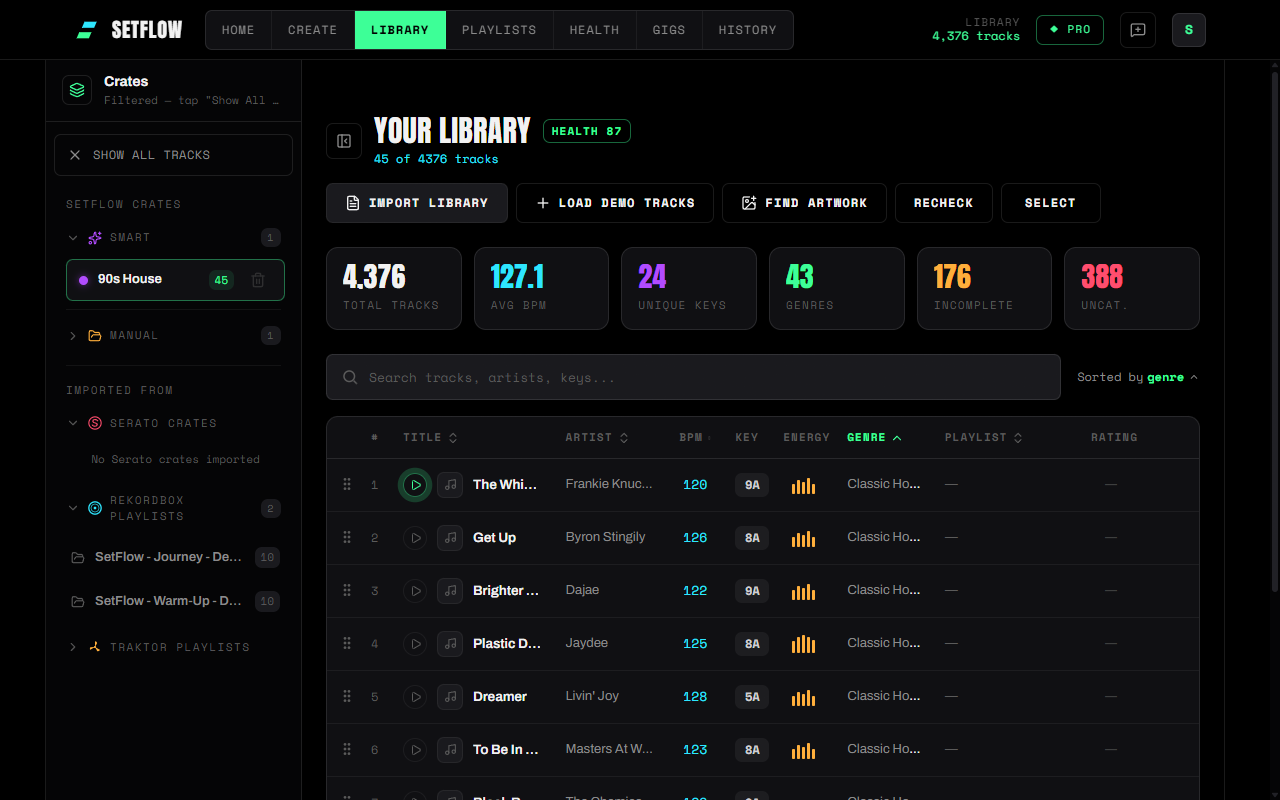
If 90s house is a regular part of what you play, do not rebuild the filter every time. A smart crate takes a year range alongside genre, BPM and energy, so “90s House” becomes a saved collection that feeds straight into the builder. Set the range to 1990 through 1999, add the genre, and it maintains itself as your library grows.
A note on tag accuracy
Release years come from the tags on your files, and tags are only as good as whoever wrote them. Remasters and compilation rips frequently carry the reissue year rather than the original, so a 1993 classic pulled from a 2015 anniversary compilation may show up as 2015. It is worth spot-checking the handful of records you care most about rather than assuming the decade filter is perfect.
The same approach works for any era
Nothing here is specific to house or to the 90s. The same two filters build an 00s R&B warm-up, a pre-70s soul opener, or a 80s disco closer. The decade is just another axis to plan against, alongside genre, BPM, key and energy.
Open the Set Builder and try a decade on your own library, or read more about harmonic mixing with the Camelot wheel.
Ready to build better sets?
Import your Rekordbox, Traktor, or Serato library and generate perfectly mixed DJ sets in seconds.
Try SetFlow Free