The Best DJ Set Builder in 2026: 5 Ways to Build a Set, Compared
A “DJ set builder” can mean anything from a drag-and-drop playlist to a tool that sequences your whole night for you. This guide compares the real options — from building sets by hand in Rekordbox to dedicated set generators — so you can pick the workflow that fits how you actually DJ.
What a Set Builder Actually Has to Do
Building a set is a sequencing problem. Whatever tool you use, it has to answer three questions for every pair of adjacent tracks:
- Do the keys work together? Harmonic compatibility is the biggest single factor in whether a transition sounds smooth or sour — the Camelot wheel maps which keys mix.
- Is the tempo step manageable? BPM differences up to about 2% blend invisibly, 4% is workable, and past 8% the stretch is audible. Genres live in different tempo lanes, so ordering controls this.
- Is the energy going somewhere? A set is an arc, not a shuffle. Building and releasing energy deliberately is what separates a set from a playlist.
Every approach below is really a different answer to “who does that work — you or the software?”
The 5 Ways to Build a DJ Set
1. By Hand in Your DJ Software
The default: make a playlist in Rekordbox, Serato or Traktor, sort by key or BPM, and drag tracks into order using the Camelot codes. It's free, it works offline, and it teaches you the craft — every DJ should build sets this way at least for a while.
The cost is time and blind spots. Ordering 25 tracks by hand while juggling key, BPM and energy is slow, and it's easy to paint yourself into a harmonic corner — a great 40-minute run that dead-ends in a key nothing else matches. Our guide to planning a DJ set covers how to do this well.
2. Smart Crates and Auto-Sort
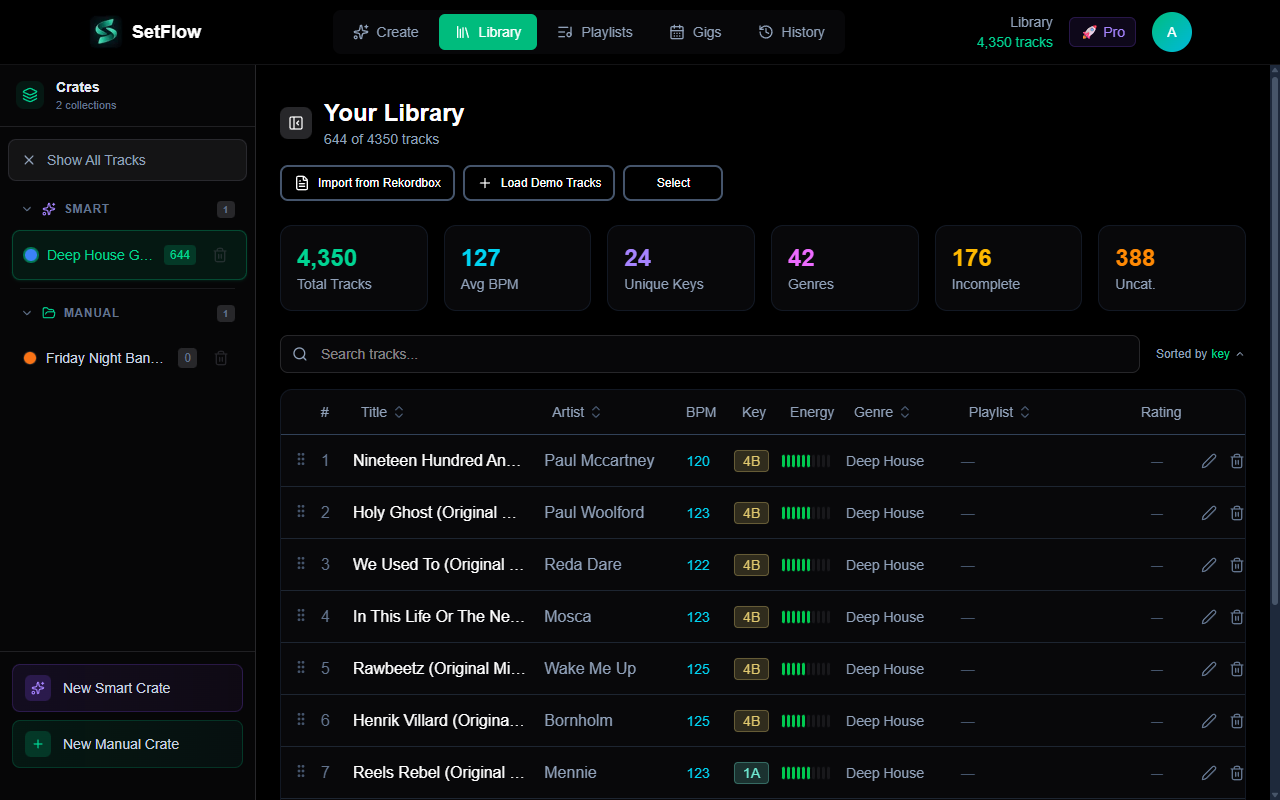
One rung up: rule-based filters. Serato's smart crates, Rekordbox's intelligent playlists and Traktor's smart lists can collect, say, every 122–126 BPM melodic house track in 8A–10A automatically. That narrows a 3,000-track library to a page of candidates in seconds.
But filters collect; they don't sequence. You still order the shortlist by hand, and the rules know nothing about energy arcs. Think of smart crates as a faster starting grid, not a set builder.
3. Key and Energy Tagging Tools
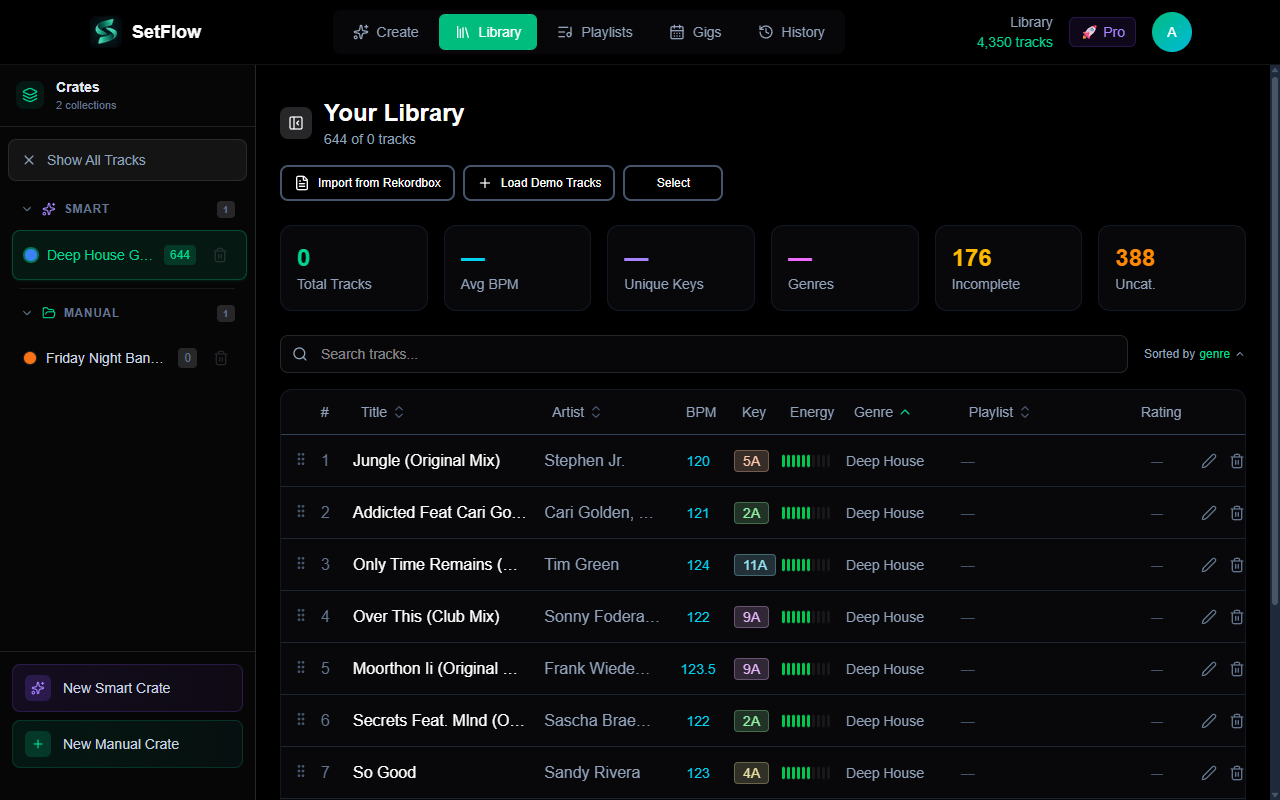
Tools like Mixed In Key exist to make your metadata better: more accurate key detection than the stock analysers, plus an energy rating written into your tags. Better data genuinely means better sets — harmonic mixing is only as good as the key tags it reads.
They're a complement, not a competitor, to a set builder: they improve the inputs, and something else — you, or a generator — still has to do the ordering. If your library's tags are a mess, start with fixing your tags before blaming your set builder.
4. Auto-Mix Features
Consumer DJ apps and party modes can chain tracks automatically with synced, crossfaded transitions. For background music at a house party, they're genuinely fine. But auto-mix picks the next track greedily; it doesn't plan a night. There's no energy arc, no build to a peak, no sense of an opener or a closer — and you can't hand its output to a pair of CDJs.
5. A Dedicated Set Generator
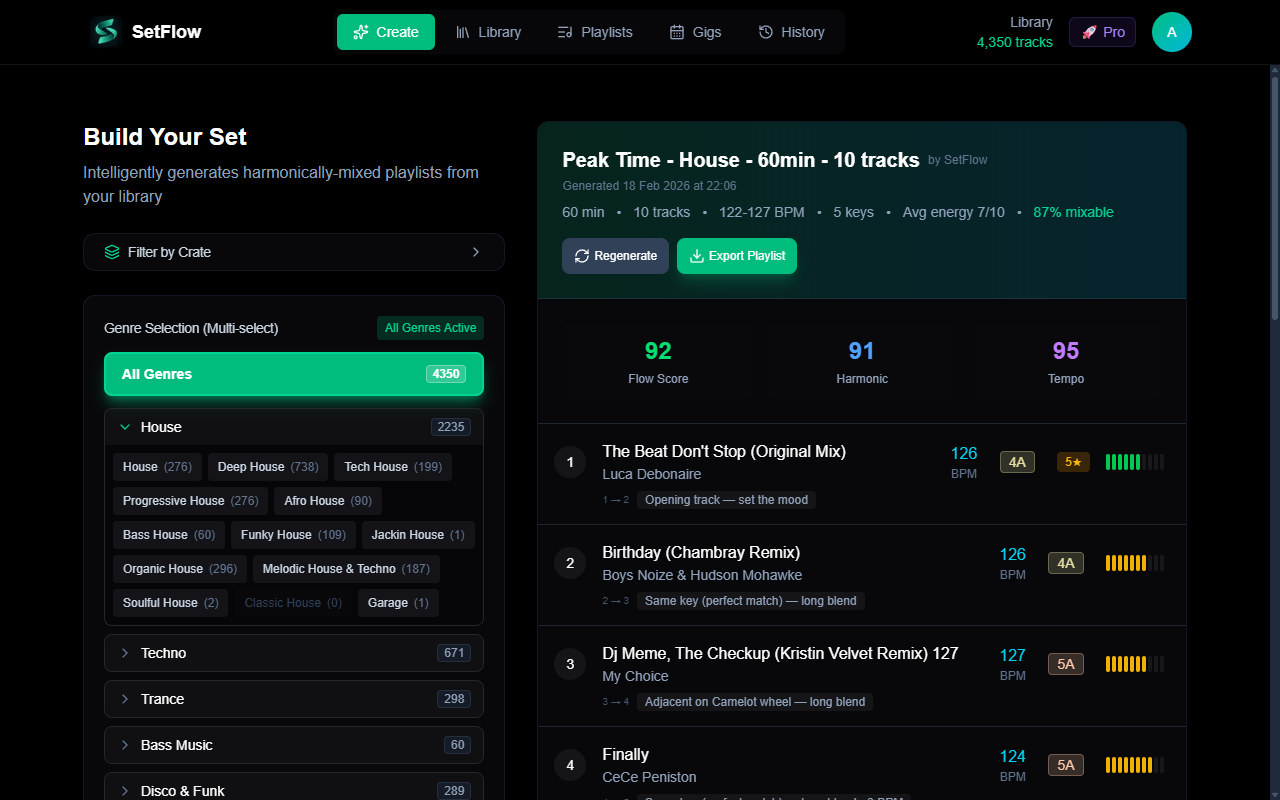
The newest category — and the one SetFlow is in — treats sequencing as the product. You import your real library (Rekordbox XML, Traktor NML or a Serato folder), pick a vibe and a set length, and the generator scores every candidate transition on harmonic compatibility, BPM step, energy flow and genre, then orders the whole set at once.
The point isn't replacing your judgement — it's doing the combinatorics you can't. Across a 25-track set from a 2,000-track library there are more possible orderings than you could audition in a lifetime; a generator finds one that flows, you swap and lock tracks until it's yours, and export back to USB for the booth in your software's native format.
Several products now do this. Our set planning software comparison puts SetFlow, Mixgraph, MixReady, DJ.Studio, Djoid and Lexicon side by side.
Side by Side
Which One Should You Use?
- You're learning to DJ — build by hand with the interactive Camelot wheel open next to your software. The reps are the point; you're training the instinct every other approach assumes.
- You gig occasionally and prep is eating your evenings — a set generator earns its keep fastest here. Import, generate, swap a few tracks, export. SetFlow's Weekend Pass exists precisely for the couple-of-gigs-a-month DJ who doesn't want another subscription.
- You play long, improvised club sets — you may never want a fully pre-ordered set, and that's legitimate. Use smart crates for candidate pools and a tagging tool for clean keys, and treat generated sets as prepared spines you can leave whenever the floor demands it.
- Your library is a mess — fix that first, whatever you choose. Bad key and genre tags sabotage every approach on this page equally.
How SetFlow Builds a Set
Since this is our comparison, here's exactly what our entry does, so you can judge it on the same terms: SetFlow imports your Rekordbox, Traktor or Serato library with BPM, key and genre intact, then scores every candidate transition — harmonic compatibility on the Camelot wheel carries the highest weight (35%), with BPM matching (25%), energy flow (15%) and genre compatibility (15%) behind it. You pick one of five energy archetypes (warm-up, peak-time, journey and friends), and it orders the set in under three seconds.
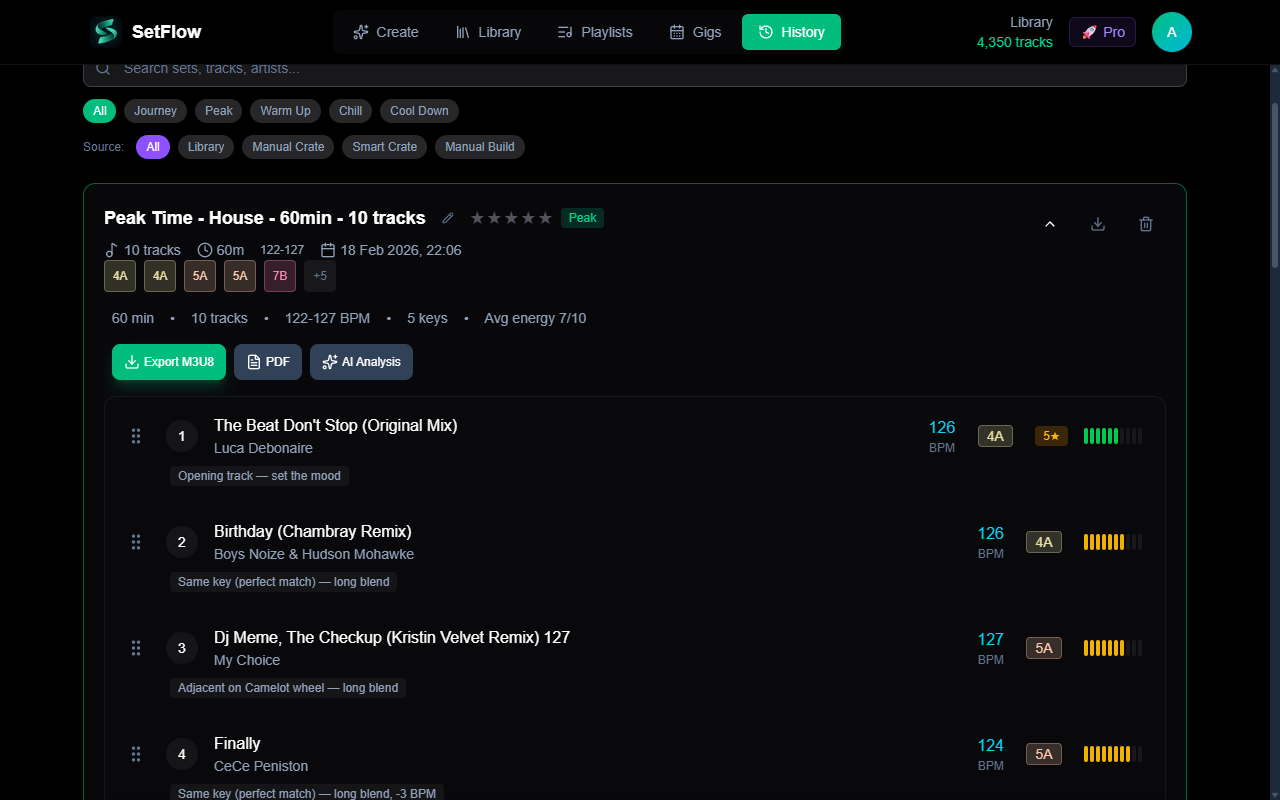
Every transition shows its scores and reasoning, you can swap or lock any track and regenerate around it, and the finished set exports as Rekordbox XML or M3U8, Serato crates, Traktor playlists, plain M3U or a PDF tracklist. Your library and cue points never leave your DJ software — SetFlow runs alongside, not instead. The playlist builder covers the fully manual mode when you want total control with the same scoring visible.
Try it free — 500 tracks, 7 days, no card — and compare its output against your last hand-built set. That's the only benchmark that matters.
Frequently Asked Questions
What is a DJ set builder?
A DJ set builder is a tool that turns a pile of tracks into an ordered set — deciding what plays when, so each transition works on key, tempo and energy. That can be as manual as dragging tracks around a playlist in Rekordbox, or as automatic as a dedicated generator like SetFlow that scores every possible transition and orders the whole set for you.
What is the difference between a playlist builder and a set builder?
A playlist builder collects tracks; a set builder orders them. A playlist is a bag of songs that fit a vibe. A set is a sequence — the same tracks in a different order can flow beautifully or clash on every mix. A true set builder cares about the joins: key compatibility, BPM steps, and the energy arc from opener to closer.
Can Rekordbox build a DJ set for me?
Not by itself. Rekordbox is excellent at preparing tracks — analysing BPM and key, tagging, and exporting to USB — and it can sort a playlist by key or BPM and suggest related tracks. But sorting is not sequencing: it won’t plan an energy arc or pick the order that makes every transition compatible. That’s what a dedicated set builder adds on top.
What is the best free DJ set builder?
For zero cost, the manual route is free forever: sort by key in your DJ software and order tracks with the Camelot wheel by hand. If you want the ordering done for you, SetFlow’s free trial imports up to 500 tracks from Rekordbox, Serato or Traktor and generates full sets free for 7 days — enough to hear the difference on your own library before paying anything.
Do professional DJs plan their sets in advance?
Most plan more than they admit. Very few professionals improvise a whole night from a raw library; they prepare ordered runs, crates for moods, and planned openers and closers, then adapt live. Planning the skeleton in advance is what buys the freedom to read the floor — you react from a strong default rather than from scratch.
Ready to build better sets?
Import your Rekordbox, Traktor, or Serato library and generate perfectly mixed DJ sets in seconds.
Try SetFlow Free