How to End a DJ Set: Land the Last 15 Minutes for Any Slot
People remember how a set ends. A great hour can finish on a track that fights the room, and a solid hour can finish so well that it's all anyone talks about. Here's how to plan the last fifteen minutes, whatever kind of slot you're playing, and how SetFlow now plans them for you.
End where your slot should end
There's no single right ending. It depends on the job your set is doing in the night. On a 1 to 10 energy scale, this is where each kind of set should finish:
| Set type | Ends at energy | Why |
|---|---|---|
| Warm-Up | 5 to 7 | Hand over a room ready for more, not one that's already peaked. |
| Peak Time | 7 to 8 | The room is at its best. Don't let it drop before the next DJ. |
| Build | 7 to 9 | The whole set climbs, so the end is the top. |
| Journey | 4 to 6 | Up to a peak and back down: the set tells a story with an ending. |
| Reset | 4 to 6 | Bring a room that's gone too hard back to somewhere it can build again. |
| Closing | 2 to 4 | The last set of the night winds down, so the lights coming up feel right. |
The most common mistake is a set that ends in the wrong place: a warm-up that finishes on the biggest record in your bag, or a closing set that's still at full tilt when the music stops.
Come down a step at a time
Getting to the right ending matters as much as the ending itself. Drop from energy 8 to energy 4 in one transition and the dancefloor feels it as a stop, not a wind-down. Two levels per track is about the most a room takes without noticing; for Chill and steady sets, one.
So plan backwards. If your closer sits at 4 and your peak is at 8, you need two or three tracks between them that step down. That's ten to fifteen minutes, so start the descent earlier than feels natural.
Keep the key for the last transitions
The end of a set is not the place for a key clash. When you have to choose between a smooth energy step and a clean key change, take the key: a slightly bigger step in key sounds better than a perfect step that clashes. Same key, one step round the Camelot wheel, or the relative major or minor are the safe moves.
Mind the artist repeats
Short sets show repeats fast. If you played Chris Lake & Green Velvet twenty minutes ago, a Chris Lake solo track as your closer reads as the same artist again. Count collaborations as the artist when you check your tracklist.
How SetFlow plans the ending
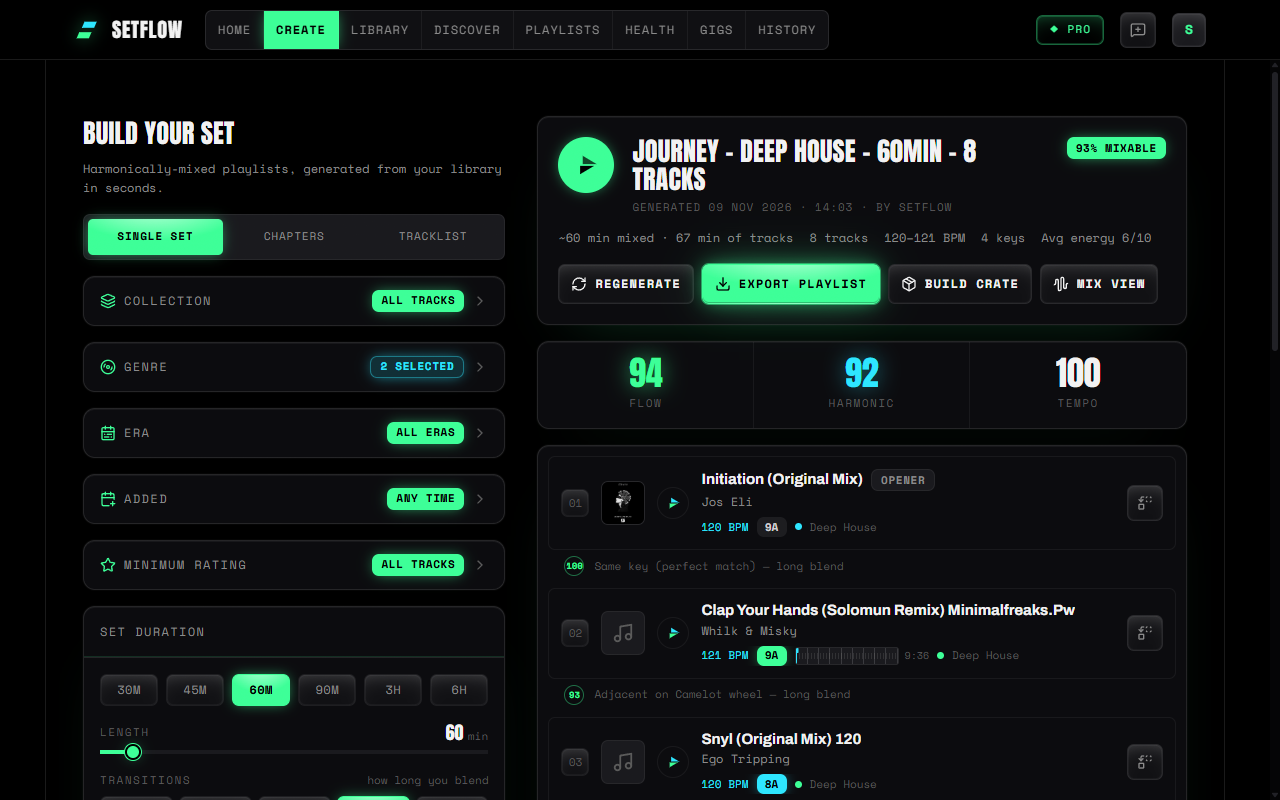
Pick a set type and a length on the Create page, and every set SetFlow builds now:
- Ends in its set type's range. The last tracks land where the table above says.
- Steps, not drops. Each track stays within the set type's energy step from the one before, whenever a track in key allows it.
- Puts the key first. When the only clean key move is a bigger step, SetFlow keeps the key.
- Counts collaborations. An artist and their collaborations are kept apart, like any repeat.
- Scores the set against its own shape. The % mixable score now checks a set against its own set type, so a Chill set isn't marked down for not peaking.
New to SetFlow? You can see a finished set in one click, built from 64 real club tracks, before you import your own library. It doesn't use any of your trial sets. For a whole night, Set Chapters in Pro chain warm-up, peak and close into one set of up to 8 hours.
Build a set on the Create page, or read what else changed in the changelog.
Frequently Asked Questions
How should I end a DJ set?
It depends on what your slot is for. A warm-up hands over to the next DJ with the energy rising, a peak-time slot ends up high, and the last set of the night winds down so the lights can come up. Plan the last few tracks so you arrive at that energy a step at a time, in key, rather than dropping straight to it.
Should a warm-up set end on a big track?
No. A warm-up should end with the room ready for more, not already given everything. Finish a level or two below peak and leave the anthems for the DJ after you. In SetFlow a Warm-Up set ends between energy 5 and 7 out of 10.
What is a good last track for a closing set?
Something the crowd knows or can sing back, at lower energy than your peak, that mixes in key from the track before. Bring the energy down over the last few tracks so the closer feels like an ending, not a sudden stop.
How big an energy jump is too big between two tracks?
On a 1 to 10 energy scale, more than two levels in one transition usually feels like a jolt, and most set types want one or two at most. Chill and Maintain sets in SetFlow allow one level per track.
Does SetFlow plan the end of my set?
Yes. Each set type in SetFlow has its own closing energy range, and the last tracks of every set land in it, in key with the track before wherever your library allows. A Journey comes back down, a Closing set winds down and a Peak Time set stays up.
Ready to build better sets?
Import your Rekordbox, Traktor, or Serato library and generate perfectly mixed DJ sets in seconds.
Try SetFlow Free